
THE INKLINGO LANGUAGE GUIDES
15 Russian Fairy Tales and Folk Tales
Meet runaway bread, a generous little house, clever animals and Baba Yaga through fifteen numbered versions in Afanasyev’s collection. Five have complete new A2 adaptations. The short source quotations and the longer learner retellings are clearly separated, with stressed Cyrillic, romanization and original English translations.
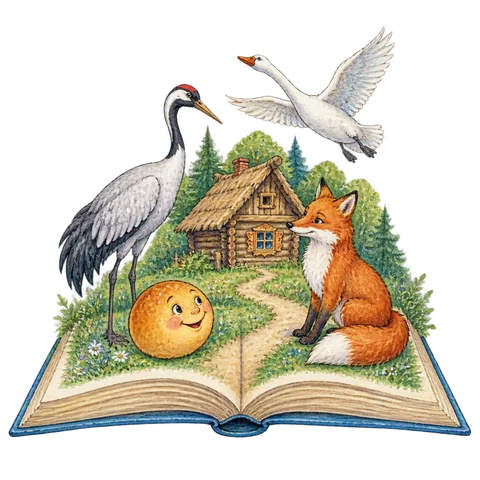
Start here
- Kolobok: The Runaway Bread RollOnce there was an old man and an old woman.
- The Fox and the CraneOne day the fox decided to treat the crane and went to invite him to visit:
- The Fox, the Hare and the RoosterOnce there lived a fox and a hare.
- The Fly’s Little HouseA fly built a little house; a crawling louse came along:
- The Swan-GeeseAn old man and an old woman lived together; they had a daughter and a little son.
Russian Fairy Tales for Beginners: Five A2 Retellings
Read these complete new adaptations one paragraph at a time. Repeated meetings and questions make the sequence easier to remember.
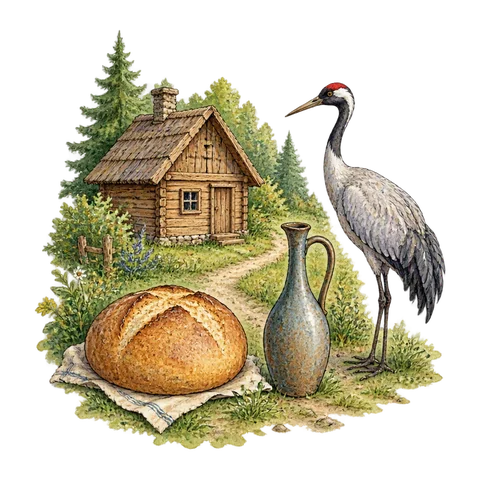
Kolobok: The Runaway Bread Roll
Жил-был со стару́хою.
Žil-byl starík so starúkhoju.
Once there was an old man and an old woman.
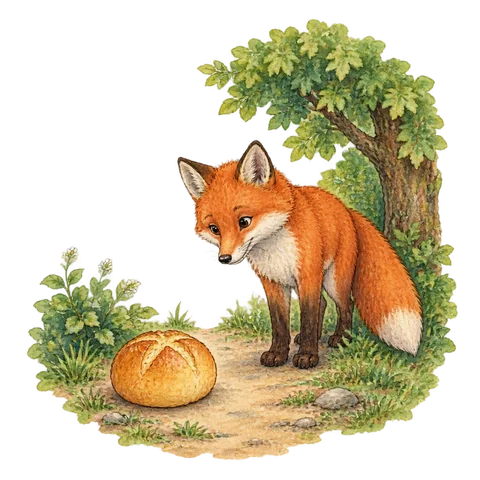
An old woman makes a small round bread roll from the flour left in the bin. It rolls away from home and escapes a hare, wolf and bear, but a flattering fox persuades it to come close enough to eat.
Cultural note: This version ends with the fox eating Kolobok. The repeated escapes make it easy to follow, but confidence and a pleasing compliment are no protection against a trick.
An A2 retelling to read and listen to
New Codex-authored A2 adaptation of Afanasyev variant 36. Simplified dialogue and explanatory scene-setting belong to this learner adaptation, not the original source wording.
В ма́леньком до́ме живу́т дед и ба́бушка. Они́ бе́дные, и муки́ у них почти́ нет. Одна́жды дед про́сит колобо́к, ма́ленький хлеб. Ба́бушка и́щет и собира́ет го́рсти. Она́ добавля́ет смета́ну, де́лает те́сто и жа́рит колобо́к в ма́сле. Пото́м кладёт его́ на окно́, что́бы он . Снача́ла он ти́хо, а пото́м начина́ет . У него́ нет ног, но фо́рма позволя́ет ему́ кати́ться. Он не остаётся ждать, когда́ его́ позову́т к столу́. За окно́м есть двор, а за дворо́м — доро́га, по кото́рой мо́жно уйти́ .
V málenʹkom dóme živút ded i bábuška. Oní bédnye, i mukí u nikh počtí net. Odnáždy ded prósit ispéčʹ kolobók, málenʹkij krúglyj khleb. Bábuška íščet mukú i sobiráet dve górsti. Oná dobavljáet smetánu, délaet tésto i žárit kolobók v másle. Potóm kladët egó na oknó, čtóby on ostýl. Snačála on ležít tíkho, a potóm načináet dvígatʹsja. U negó net nog, no krúglaja fórma pozvoljáet emú katítʹsja. On ne ostaëtsja ždatʹ, kogdá egó pozovút k stolú. Za oknóm estʹ dvor, a za dvoróm — doróga, po kotóroj móžno ujtí dalekó.
Колобо́к пры́гает с окна́ на скамью́, со скамьи́ на пол. Он ка́тится че́рез дверь, по сту́пенькам и во двор. он уже́ на доро́ге. Навстре́чу ему́ идёт за́яц. За́яц его́ съесть, но колобо́к про́сит пе́сенку. В ней он расска́зывает, как ушёл от де́да и ба́бушки. Пока́ за́яц слу́шает, путе́шественник ка́тится да́льше.
Kolobók prýgaet s okná na skamʹjú, so skamʹí na pol. On kátitsja čérez dverʹ, po stúpenʹkam i vo dvor. Skóro on užé na doróge. Navstréču emú idët zájac. Zájac khóčet egó sʺestʹ, no kolobók prósit poslúšatʹ pésenku. V nej on rasskázyvaet, kak ušël ot déda i bábuški. Poká zájac slúšaet, krúglyj putéšestvennik kátitsja dálʹše.
Пото́м колобо́к встреча́ет во́лка, а за ним медве́дя. Оба́ го́лодные и оба́ его́ съесть. Но колобо́к поёт о свои́х приклю́чениях. в его́ пе́сне есть и за́яц. Ка́ждый раз он успева́ет укати́ться. Колобо́к ду́мает, что он о́чень у́мный и что никто́ не мо́жет его́ пойма́ть. Впереди́ он ви́дит лису́. Она́ говори́т ла́сково и не торо́пится.
Potóm kolobók vstrečáet vólka, a za nim medvédja. Obá gólodnye i obá khótjat egó sʺestʹ. No kolobók snóva poët o svoíkh prikljúčenijakh. Tepérʹ v egó pésne estʹ i zájac. Káždyj raz on uspeváet ukatítʹsja. Kolobók dúmaet, čto on óčenʹ úmnyj i čto niktó ne móžet egó pojmátʹ. Vperedí on vídit lisú. Oná govorít láskovo i ne torópitsja.
про́сит спеть ещё раз: ей о́чень нра́вится пе́сня. Она́ говори́т, что и пло́хо слы́шит. Колобо́к пры́гает ей на нос и начина́ет снача́ла. Пото́м про́сит его́ сесть ей на язы́к, что́бы слы́шать ещё лу́чше. Он ве́рит ей и пры́гает. В э́тот моме́нт его́ съеда́ет. Так доро́га колобка́: он избежа́л откры́той опа́сности, но прия́тным слова́м.
Lisá prósit spetʹ eščë raz: ej óčenʹ nrávitsja pésnja. Oná govorít, čto stáraja i plókho slýšit. Kolobók prýgaet ej na nos i načináet snačála. Potóm lisá prósit egó sestʹ ej na jazýk, čtóby slýšatʹ eščë lúčše. On vérit ej i prýgaet. V è́tot momént lisá egó sʺedáet. Tak končáetsja doróga kolobká: on izbežál otkrýtoj opásnosti, no povéril prijátnym slovám.
Easy
— Traditional; collected by Alexander Afanasyev (Collector: 1826–1871), Afanasyev, Russian Folk Tales, no. 36 (Колобок)
 Source note
The Fox and the Crane
Вот и взду́мала одна́жды угости́ть журавля́, пошла́ звать его́ к себе́ в го́сти:
Vot i vzdúmala odnáždy lisá ugostítʹ žuravljá, pošlá zvatʹ egó k sebé v gósti:
One day the fox decided to treat the crane and went to invite him to visit:
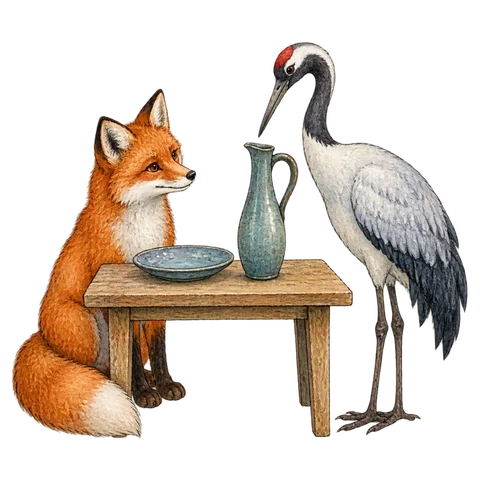
A fox serves porridge on a flat plate that her crane guest cannot use. He returns the invitation with cold soup in a narrow jug. Both hosts eat well while their guest goes hungry, and the friendship ends.
Cultural note: The joke concerns hospitality that ignores a guest’s needs. The source ends in estrangement, not in a shared meal or a reconciliation.
An A2 retelling to read and listen to
New Codex-authored A2 adaptation of Afanasyev variant 33. Simplified dialogue and explanatory scene-setting belong to this learner adaptation, not the original source wording.
и жура́вль . Одна́жды реши́ла дру́га на обе́д. Она́ пришла́ к нему́ и сказа́ла, что пригото́вит вку́сную еду́. Жура́вль обра́довался приглаше́нию. Он захоте́л провести́ вре́мя с подру́гой и попро́бовать её угоще́ние. К назна́ченному вре́мени он пошёл к лисе́. У неё уже́ всё бы́ло гото́во, и она́ позвала́ его́ к столу́.
Lisá i žurávlʹ družíli. Odnáždy lisá rešíla priglasítʹ drúga na obéd. Oná prišlá k nemú i skazála, čto prigotóvit vkúsnuju edú. Žurávlʹ obrádovalsja priglašéniju. On zakhotél provestí vrémja s podrúgoj i popróbovatʹ eë ugoščénie. K naznáčennomu vrémeni on pošël k lisé. U neë užé vsë býlo gotóvo, i oná pozvalá egó k stolú.
свари́ла ма́нную ка́шу и положи́ла её на пло́скую . Ка́ши бы́ло немно́го, и она́ лежа́ла то́нким сло́ем. предложи́ла го́стю есть. Жура́вль наклони́лся к таре́лке и постуча́л по ней дли́нным клю́вом. Но ка́шу взять не смог. Он попро́бовал ещё раз, пото́м ещё. те́м вре́менем лиза́ла ка́шу и говори́ла, что друго́й у неё нет. Для неё была́ удо́бной: язы́к легко́ собира́л всю еду́. А у журавля́ был совсе́м друго́й рот. Хозя́йка могла́ ви́деть, как он стара́ется, но ка́ша всё равно́ остава́лась на таре́лке. Угоще́ние доста́лось то́лько ей.
Lisá svaríla mánnuju kášu i položíla eë na plóskuju tarélku. Káši býlo nemnógo, i oná ležála tónkim slóem. Lisá predložíla góstju estʹ. Žurávlʹ naklonílsja k tarélke i postučál po nej dlínnym kljúvom. No kášu vzjatʹ ne smog. On popróboval eščë raz, potóm eščë. Lisá tém vrémenem lizála kášu i govoríla, čto drugój edý u neë net. Dlja neë tarélka bylá udóbnoj: jazýk legkó sobirál vsju edú. A u žuravljá byl sovsém drugój rot. Khozjájka moglá vídetʹ, kak on staráetsja, no káša vsë ravnó ostaválasʹ na tarélke. Ugoščénie dostálosʹ tólʹko ej.
Когда́ ста́ла пусто́й, жура́вль всё ещё был го́лоден. Он поблагодари́л лису́ и пригласи́л её к себе́ на день. согласи́лась. Она́ поду́мала, что хорошо́ пое́ст у дру́га. Жура́вль пригото́вил окро́шку, холо́дный , и нали́л её в высо́кий кувши́н с у́зким го́рлышком. Когда́ пришла́, он поста́вил кувши́н пе́ред ней и предложи́л угоща́ться.
Kogdá tarélka stála pustój, žurávlʹ vsë eščë byl góloden. On poblagodaríl lisú i priglasíl eë k sebé na slédujuščij denʹ. Lisá soglasílasʹ. Oná podúmala, čto khorošó poést u drúga. Žurávlʹ prigotóvil okróšku, kholódnyj sup, i nalíl eë v vysókij kuvšín s úzkim górlyškom. Kogdá lisá prišlá, on postávil kuvšín péred nej i predložíl ugoščátʹsja.
крути́лась во́круг кувши́на. Она́ ню́хала его́, лиза́ла снару́жи и пыта́лась просу́нуть нос . Но го́рлышко бы́ло сли́шком у́зким. Жура́вль легко́ опуска́л клюв в кувши́н и ел. Вско́ре зако́нчился. Хозя́ин сказа́л, что бо́льше угости́ть не́чем. ушла́ голо́дной и серди́той. По́сле э́того они́ переста́ли . Ка́ждый устро́ил обе́д удо́бно для себя́, но неудо́бно для го́стя.
Lisá krutílasʹ vókrug kuvšína. Oná njúkhala egó, lizála snarúži i pytálasʹ prosúnutʹ nos vnutrʹ. No górlyško býlo slíškom úzkim. Žurávlʹ legkó opuskál kljuv v kuvšín i el. Vskóre sup zakónčilsja. Khozjáin skazál, čto bólʹše ugostítʹ néčem. Lisá ušlá domój golódnoj i serdítoj. Pósle è́togo oní perestáli družítʹ. Káždyj ustróil obéd udóbno dlja sebjá, no neudóbno dlja góstja.
Easy
— Traditional; collected by Alexander Afanasyev (Collector: 1826–1871), Afanasyev, Russian Folk Tales, no. 33 (Лиса и журавль)
 Source note
The Fox, the Hare and the Rooster
Жи́ли-бы́ли да за́яц.
Žíli-býli lisá da zájac.
Once there lived a fox and a hare.
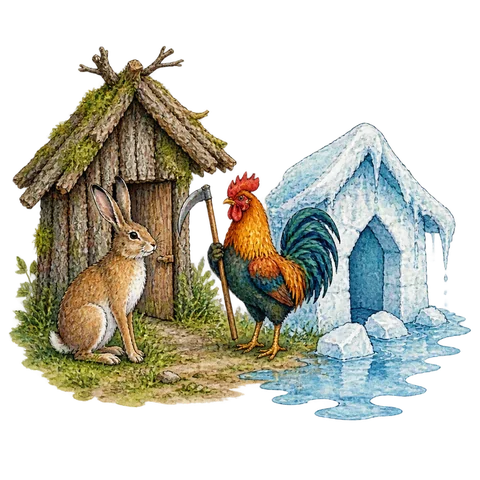
After the fox’s ice house melts, she takes over the hare’s bark house. Dogs, a bear and a bull fail to remove her. A rooster with a scythe finally restores the house to the hare.
Cultural note: Afanasyev’s version has a violent ending: the rooster kills the fox. Many modern versions soften this; the adaptation here states the event briefly without graphic detail.
An A2 retelling to read and listen to
New Codex-authored A2 adaptation of Afanasyev variant 14. Simplified dialogue and explanatory scene-setting belong to this learner adaptation, not the original source wording.
В лесу́ жи́ли и за́яц. У лисы́ был дом изо льда́, а у за́йца про́стая избу́шка из ко́ры. Зимо́й оба́ до́ма стоя́ли це́лыми. Но весно́й ста́ло тепло́, и ледяно́й дом раста́ял. попроси́лась к за́йцу погре́ться. Он пусти́л её внутрь. Тогда́ она́ вы́гнала хозя́ина и оста́лась в его́ избу́шке одна́.
V lesú žíli lisá i zájac. U lisý byl krasívyj dom izo lʹdá, a u zájca próstaja izbúška iz kóry. Zimój obá dóma stojáli célymi. No vesnój stálo tepló, i ledjanój dom rastájal. Lisá poprosílasʹ k zájcu pogrétʹsja. On pustíl eë vnutrʹ. Togdá oná výgnala khozjáina i ostálasʹ v egó izbúške odná.
За́яц шёл по доро́ге и пла́кал. Ему́ бы́ло жа́лко свой дом. Навстре́чу бе́жали соба́ки. Они́ спроси́ли, что случи́лось, и реши́ли . Соба́ки подошли́ к избу́шке и потребова́ли, что́бы ушла́. Но она́ отве́тила стра́шными угро́зами. Соба́ки испуга́лись и убежа́ли. За́яц оста́лся без . Он не мог верну́ться и продо́лжил свой путь.
Zájac šël po doróge i plákal. Emú býlo žálko svoj dom. Navstréču béžali sobáki. Oní sprosíli, čto slučílosʹ, i rešíli pomóčʹ. Sobáki podošlí k izbúške i potrebováli, čtóby lisá ušlá. No oná otvétila strášnymi ugrózami. Sobáki ispugálisʹ i ubežáli. Zájac snóva ostálsja bez pómošči. On ne mog vernútʹsja domój i prodólžil svoj putʹ.
Пото́м за́яц встре́тил медве́дя. Большо́й медве́дь то́же вы́гнать лису́. Одна́ко у две́ри он услы́шал те же угро́зы и убежа́л. За ним попро́бовал бык, но и он испуга́лся. Так по́пытки зако́нчились одина́ково. сиде́ла в чу́жом до́ме, а за́яц всё . На доро́ге появи́лся пету́х. Он нёс косу́ и спроси́л за́йца о его́ беде́. За́яц расска́зал всё с са́мого нача́ла. Он вспо́мнил свою́ до́брую лисе́, поте́рю до́ма и обеща́ния си́льных зве́рей. Ему́ бы́ло тру́дно наде́яться на ма́ленькую пти́цу, когда́ да́же медве́дь и бык не смогли́ ему́ .
Potóm zájac vstrétil medvédja. Bolʹšój medvédʹ tóže obeščál výgnatʹ lisú. Odnáko u dvéri on uslýšal te že ugrózy i ubežál. Za nim popróboval byk, no i on ispugálsja. Tak tri pópytki zakónčilisʹ odinákovo. Lisá sidéla v čúžom dóme, a zájac vsë plákal. Na doróge pojavílsja petúkh. On nës kosú i sprosíl zájca o egó bedé. Zájac rasskázal vsë s sámogo načála. On vspómnil svojú dóbruju pómoščʹ lisé, potérju dóma i obeščánija sílʹnykh zvérej. Emú býlo trúdno nadéjatʹsja na málenʹkuju ptícu, kogdá dáže medvédʹ i byk ne smoglí emú pomóčʹ.
За́яц уже́ не ве́рил в , но пету́х пошёл к избу́шке. Он позва́л лису́ и пригрози́л ей косо́й. На э́тот раз испуга́лась она́. Снача́ла сказа́ла, что одева́ется, пото́м — что надева́ет шу́бу. Пету́х повторя́л своё тре́бование. Когда́ вы́шла, он уби́л её косо́й. За́яц верну́лся в свой дом. С тех пор они́ с петухо́м ста́ли жить вме́сте.
Zájac užé ne véril v pómoščʹ, no petúkh pošël k izbúške. On grómko pozvál lisú i prigrozíl ej kosój. Na è́tot raz ispugálasʹ oná. Snačála lisá skazála, čto odeváetsja, potóm — čto nadeváet šúbu. Petúkh povtorjál svoë trébovanie. Kogdá lisá nakónec výšla, on ubíl eë kosój. Zájac vernúlsja v svoj dom. S tekh por oní s petukhóm stáli žitʹ vméste.
Easy
— Traditional; collected by Alexander Afanasyev (Collector: 1826–1871), Afanasyev, Russian Folk Tales, no. 14 (Лиса, заяц и петух)
 Source note
The Fly’s Little House
Постро́ила те́рем; пришла́ вошь-поползу́ха:
Postróila múkha térem; prišlá vošʹ-popolzúkha:
A fly built a little house; a crawling louse came along:
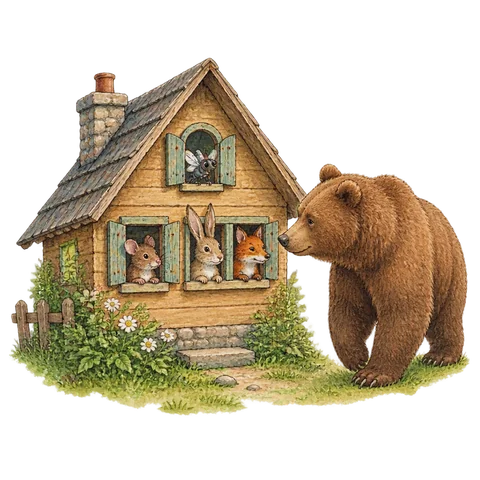
A fly welcomes a growing group of insects and animals into her house. Each newcomer asks who lives there, and the occupants name themselves. A bear arrives as the crusher of them all and destroys the house with his paw.
Cultural note: This is variant 82, with the fly as builder. It ends when the bear breaks the house; it does not describe the familiar modern ending in which everyone builds a larger home.
An A2 retelling to read and listen to
New Codex-authored A2 adaptation of Afanasyev variant 82. Simplified dialogue and explanatory scene-setting belong to this learner adaptation, not the original source wording.
постро́ила ма́ленький те́рем. Те́рем — э́то дом, кото́рый в ска́зке мо́жет и краси́вой ба́шней. жила́ в нём одна́. Одна́жды к до́му подошла́ вошь и спроси́ла, кто там живёт. отве́тила и пригласи́ла её . Так в те́реме ста́ли жить дво́е. появи́лась ещё одна́ го́стья, ма́ленькая блоха́. Она́ то́же захоте́ла посели́ться в до́ме.
Múkha postróila málenʹkij térem. Térem — è́to dom, kotóryj v skázke móžet nazyvátʹsja i krasívoj bášnej. Múkha žilá v nëm odná. Odnáždy k dómu podošlá vošʹ i sprosíla, kto tam živët. Múkha otvétila i priglasíla eë vnutrʹ. Tak v téreme stáli žitʹ dvóe. Skóro pojavílasʹ eščë odná góstʹja, málenʹkaja blokhá. Oná tóže zakhotéla poselítʹsja v dóme.
У две́ри блоха́ зада́ла тот же вопро́с. Те, кто был внутри́, назва́ли себя́. Го́стья сказа́ла, кто она́, и вошла́. Пото́м кома́р с дли́нными нога́ми. Он не зна́л жильцо́в и снача́ла спроси́л их имена́. Ему́ отве́тили , вошь и блоха́. Кома́р присоедини́лся к ним. В ма́леньком те́реме бы́ло уже́ че́тверо жильцо́в.
U dvéri blokhá zadála tot že voprós. Te, kto byl vnutrí, nazváli sebjá. Góstʹja skazála, kto oná, i vošlá. Potóm priletél komár s dlínnymi nogámi. On ne znál žilʹcóv i snačála sprosíl ikh imená. Emú otvétili múkha, vošʹ i blokhá. Komár prisoedinílsja k nim. V málenʹkom téreme tepérʹ býlo užé čétvero žilʹcóv.
к те́рему прибежа́ла мышь, а за ней — я́щерица. Ка́ждый раз но́вый гость спра́шивал, кто живёт в до́ме. И ка́ждый раз отве́т станови́лся дли́ннее, потому́ что жильцо́в бы́ло всё бо́льше. Пото́м пришла́ , за ней за́яц, а по́сле него́ волк. Все они́ вошли́ в те́рем. Но́вые жильцы́ бы́ли совсе́м не похо́жи на пе́рвых. Одни́ уме́ли лета́ть, други́е бе́гали по земле́. Но у ка́ждого бы́ло своё и́мя в о́бщем отве́те. Коро́ткий вопро́с у две́ри свя́зывал все встре́чи в одну́ исто́рию. , кото́рая постро́ила дом, де́лила его́ с це́лой ко́мпанией.
Zatém k téremu pribežála myšʹ, a za nej — jáščerica. Káždyj raz nóvyj gostʹ sprášival, kto živët v dóme. I káždyj raz otvét stanovílsja dlínnee, potomú čto žilʹcóv býlo vsë bólʹše. Potóm prišlá lisá, za nej zájac, a pósle negó volk. Vse oní vošlí v térem. Nóvye žilʹcý býli sovsém ne pokhóži na pérvykh. Odní uméli letátʹ, drugíe bégali po zemlé. No u káždogo býlo svoë ímja v óbščem otvéte. Korótkij voprós u dvéri svjázyval vse vstréči v odnú istóriju. Múkha, kotóraja postróila dom, tepérʹ délila egó s céloj kómpaniej.
появи́лся медве́дь. Он то́же спроси́л, кто живёт в те́реме. Из до́ма ему́ отве́тили все по по́рядку, от ма́ленькой до во́лка. Они́ захоте́ли узна́ть, кто пришёл к ним на э́тот раз. Медве́дь назва́л себя́ тем, кто всех разда́вит. Он не стал ждать . Си́льно уда́рил ла́пой по до́му и разру́шил его́. э́та .
Nakonéc pojavílsja medvédʹ. On tóže sprosíl, kto živët v téreme. Iz dóma emú otvétili vse po pórjadku, ot málenʹkoj múkhi do sérogo vólka. Oní zakhotéli uznátʹ, kto prišël k nim na è́tot raz. Medvédʹ nazvál sebjá tem, kto vsekh razdávit. On ne stal ždatʹ priglašénija. Sílʹno udáril lápoj po dómu i razrúšil egó. Zdesʹ è́ta stáraja vérsija skázki končáetsja.
Easy
— Traditional; collected by Alexander Afanasyev (Collector: 1826–1871), Afanasyev, Russian Folk Tales, no. 82 (Терем мухи)
 Source note
The Swan-Geese
Жи́ли старичо́к со стару́шкою; у них была́ до́чка да сыно́к .
Žíli staričók so starúškoju; u nikh bylá dóčka da synók málenʹkij.
An old man and an old woman lived together; they had a daughter and a little son.
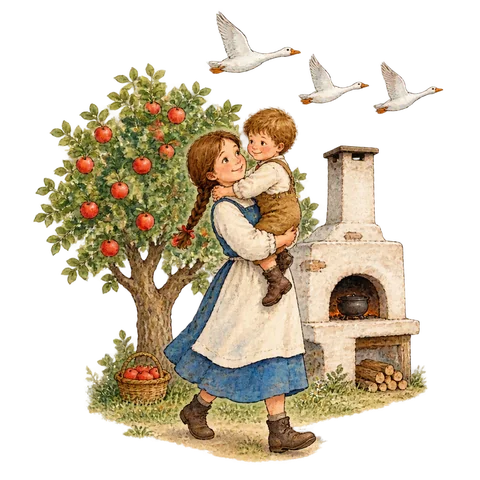
A girl leaves her little brother to play, and swan-geese carry him away. She refuses food from a stove, apple tree and river on the outward journey. After rescuing him from Baba Yaga, she accepts their food and receives their protection.
Cultural note: This particular version has a hedgehog who gives directions and a brother playing with golden apples. The magical hiding places belong to the tale, not to practical advice for children.
An A2 retelling to read and listen to
New Codex-authored A2 adaptation of Afanasyev variant 113. Simplified dialogue and explanatory scene-setting belong to this learner adaptation, not the original source wording.
Оте́ц и мать уходя́т на рабо́ту. Они́ про́сят до́чку сле́дить за ма́леньким бра́том и обеща́ют пода́рок. Но де́вочка сажа́ет его́ на тра́ву под окно́м и игра́ть. Когда́ она́ возвраща́ется, бра́та нет. Вдали́ летя́т гу́си-ле́беди. Де́вочка понима́ет, что пти́цы унесли́ , и бежи́т за ни́ми. она́ верну́ться одна́.
Otéc i matʹ ukhodját na rabótu. Oní prósjat dóčku sléditʹ za málenʹkim brátom i obeščájut podárok. No dévočka sažáet egó na trávu pod oknóm i ubegáet igrátʹ. Kogdá oná vozvraščáetsja, bráta net. Vdalí letját gúsi-lébedi. Dévočka ponimáet, čto ptícy uneslí málʹčika, i bežít za ními. Tepérʹ oná boítsja vernútʹsja domój odná.
На доро́ге стои́т печь. Де́вочка , полете́ли пти́цы. Печь предлага́ет снача́ла съесть ржано́й пирожо́к, но де́вочка отка́зывается. Пото́м она́ встреча́ет я́блоню. Та про́сит съесть я́блоко, но де́вочка сно́ва не . Мо́лочная река́ с берега́ми из киселя́ то́же предлага́ет угоще́ние. Де́вочка отверга́ет и его́. Никто́ из них не пока́зывает доро́гу.
Na doróge stoít pečʹ. Dévočka sprášivaet, kudá poletéli ptícy. Pečʹ predlagáet snačála sʺestʹ ržanój pirožók, no dévočka otkázyvaetsja. Potóm oná vstrečáet díkuju jáblonju. Ta prósit sʺestʹ jábloko, no dévočka snóva ne khóčet. Móločnaja reká s beregámi iz kiseljá tóže predlagáet ugoščénie. Dévočka otvergáet i egó. Niktó iz nikh ne pokázyvaet dorógu.
В лесу́ де́вочка ви́дит ежа́. Он пока́зывает ей, идти́. она́ нахо́дит избу́шку на ку́рьих . Там живёт ба́ба-яга́, а брат де́вочки сиди́т и игра́ет золоты́ми я́блоками. Де́вочка бы́стро берёт его́ и . Но гу́си-ле́беди замеча́ют побе́г и летя́т сле́дом. С бра́том на рука́х трудне́е бежа́ть. Де́вочке о́чень нужна́ .
V lesú dévočka vídit ežá. On pokázyvaet ej, kudá idtí. Skóro oná nakhódit izbúšku na kúrʹikh nóžkakh. Tam živët bába-jagá, a brat dévočki sidít i igráet zolotými jáblokami. Dévočka býstro berët egó i ubegáet. No gúsi-lébedi zamečájut pobég i letját slédom. S brátom na rukákh trudnée bežátʹ. Dévočke óčenʹ nužná pómoščʹ.
Она́ добега́ет до реки́ и про́сит спря́тать их. На э́тот раз де́вочка ест кисе́ль и . Река́ дете́й под бе́регом, и пти́цы пролета́ют ми́мо. де́вочка бежи́т к я́блоне. Она́ съеда́ет я́блоко, и де́рево закрыва́ет её ве́тками. В после́дний раз она́ про́сит у пе́чи. Де́вочка съеда́ет пирожо́к и пря́чется с бра́том внутри́.
Oná dobegáet do rekí i prósit sprjátatʹ ikh. Na è́tot raz dévočka est kisélʹ i blagodarít. Reká prjáčet detéj pod béregom, i ptícy proletájut mímo. Zatém dévočka bežít k jáblone. Oná sʺedáet jábloko, i dérevo zakryváet eë vétkami. V poslédnij raz oná prósit pómošči u péči. Dévočka sʺedáet pirožók i prjáčetsja s brátom vnutrí.
Гу́си-ле́беди не мо́гут найти́ дете́й. Они́ лета́ют побли́зости, крича́т, а пото́м возвраща́ются без . Де́вочка выхо́дит из укры́тия и бежи́т . Она́ успева́ет бра́та ра́ньше, чем возвраща́ются роди́тели. Во вре́мя доро́ги она́ научи́лась принима́ть про́стое угоще́ние и говори́ть . Те, кому́ она́ снача́ла отка́зывала, в са́мый моме́нт помогли́ ей бра́та.
Gúsi-lébedi ne mógut najtí detéj. Oní letájut poblízosti, kričát, a potóm vozvraščájutsja bez málʹčika. Dévočka vykhódit iz ukrýtija i bežít domój. Oná uspeváet prinestí bráta ránʹše, čem vozvraščájutsja rodíteli. Vo vrémja dorógi oná naučílasʹ prinimátʹ próstoe ugoščénie i govorítʹ spasíbo. Te, komú oná snačála otkázyvala, v sámyj núžnyj momént pomoglí ej spastí bráta.
Easy
— Traditional; collected by Alexander Afanasyev (Collector: 1826–1871), Afanasyev, Russian Folk Tales, no. 113 (Гуси-лебеди)
 Source note
Explore these words: Animals (flashcards) · Directions & position (flashcards) · Time & dates (flashcards)
Put these words into context with a story at your level.
Read Russian storiesFamous Russian Fairy Tales: Baba Yaga and Magical Helpers
These collected versions contain powerful helpers and frightening tests. Their notes identify violent details often softened in modern children’s editions.
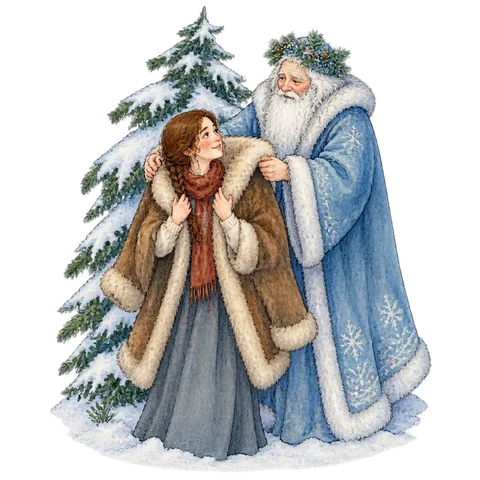
Morozko: Father Frost
Моро́зко сжа́лился, оку́тал де́вицу шу́бами и отогре́л одея́лами.
Tut Morózko sžálilsja, okútal dévicu šúbami i otogrél odejálami.
Then Morozko took pity, wrapped the girl in fur coats and warmed her with blankets.
An old woman sends her stepdaughter Marfusha into the frozen forest. The girl answers Frost patiently and receives warmth and gifts. Hoping for the same reward, the woman sends her own two daughters, whose rude replies lead to their deaths.
Cultural note: Variant 95 has two favored daughters. Its contrast between courtesy and cruelty comes through a harsh, abusive family story; the deaths should not be hidden when choosing it for children.
Intermediate
— Traditional; collected by Alexander Afanasyev (Collector: 1826–1871), Afanasyev, Russian Folk Tales, no. 95 (Морозко)
 Source note
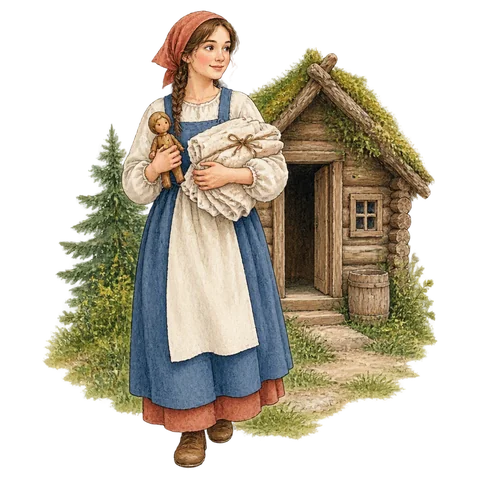
Vasilisa the Beautiful
В не́котором ца́рстве жил-был купе́ц.
V nékotorom cárstve žil-byl kupéc.
In a certain kingdom there lived a merchant.
Vasilisa’s dying mother gives her a helpful doll. Sent to fetch fire from Baba Yaga, she survives difficult tasks with the doll’s help and returns with a burning skull. Later, her remarkable weaving brings her to the tsar’s attention.
Cultural note: The doll carries the mother’s blessing through the story. The skull burns the cruel stepfamily to death; this famous magical tale is more frightening than its title alone suggests.
Hard
— Traditional; collected by Alexander Afanasyev (Collector: 1826–1871), Afanasyev, Russian Folk Tales, no. 104 (Василиса Прекрасная)
 Source note
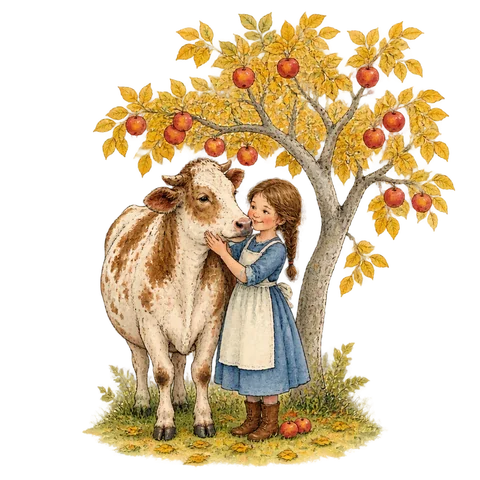
Little Khavroshechka
А бы́ли у её хозя́йки до́чери больши́е.
A býli u eë khozjájki tri dóčeri bolʹšíe.
Now her mistress had three grown daughters.
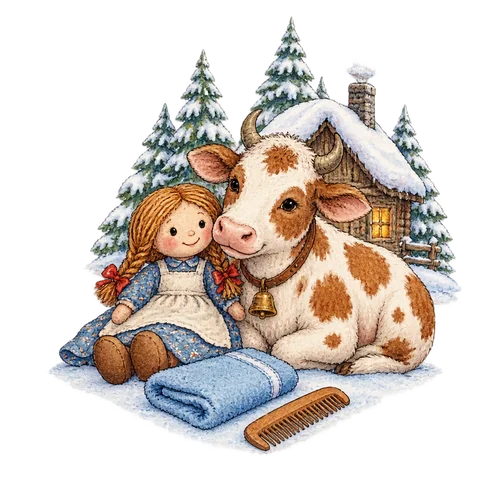
An overworked orphan receives magical help from a cow. Three sisters spy on her; the girl lulls two eyes to sleep but forgets the third sister’s extra eye. After the cow is killed, its buried bones become an apple tree that helps the girl escape her unhappy life.
Cultural note: The cow combines comfort, work and protection. The eye-counting episodes create a memorable pattern, but the source also contains cruelty and the loss of an animal companion.
Intermediate
— Traditional; collected by Alexander Afanasyev (Collector: 1826–1871), Afanasyev, Russian Folk Tales, no. 100 (Крошечка-Хаврошечка)
 Source note
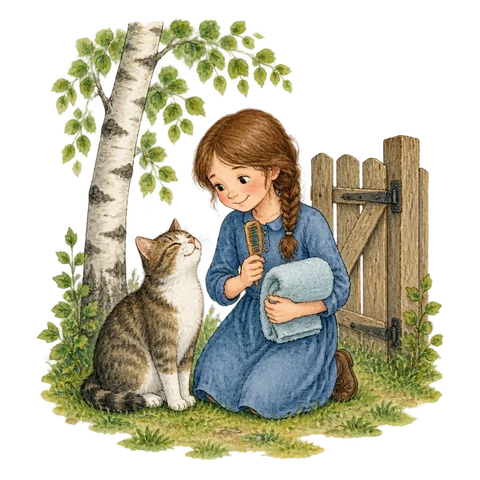
Baba Yaga and the Helpful Cat
ха́тка, а в ней ба́ба-яга́ костяна́я и ткёт.
Stoít khátka, a v nej sidít bába-jagá kostjanája nogá i tkët.
There stands a hut, and inside sits Baba Yaga, Bony Leg, weaving.
A stepmother sends a girl to Baba Yaga for a needle and thread. Following her own aunt’s advice, the girl gives food and gifts to the witch’s neglected helpers. A grateful cat gives her a comb and towel that become barriers during her escape.
Cultural note: This is variant 103, with the helpful cat, dogs, gate and birch. The girl escapes through reciprocity; the original also ends with her father killing the stepmother.
Hard
— Traditional; collected by Alexander Afanasyev (Collector: 1826–1871), Afanasyev, Russian Folk Tales, no. 103 (Баба-яга)
 Source note
Explore these words: Directions & position (flashcards) · Time & dates (flashcards) · Numbers (flashcards)
Put these words into context with a story at your level.
Read Russian storiesRussian Animal and Object Tales: Tricks, Choices and Consequences
Foxes, birds, a fish and three unlikely travelers show how cleverness, cooperation and misunderstandings shape a tale. Compare their choices and the consequences that follow.
Sister Fox and the Wolf
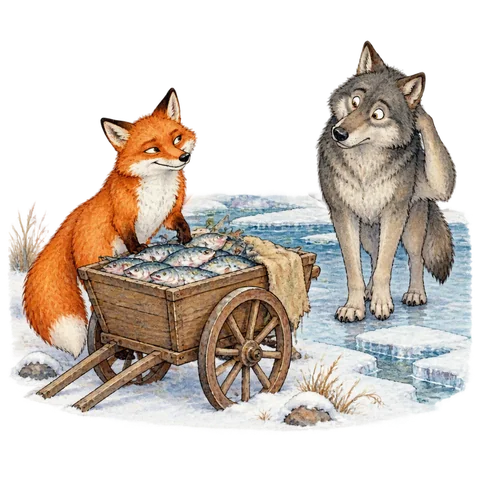
Налови́л и воз.
Nalovíl rýby i vezët domój célyj voz.
He caught fish and is taking a whole cartload home.
A fox pretends to be dead and steals fish from a man’s cart. She sends a wolf to fish with his tail in an ice hole, then pretends her dough-covered head is badly injured so that he carries her. Further tricks continue in this long version.
Cultural note: The fox is an entertaining deceiver, not a model of kindness. This entry summarizes the opening episodes of variant 1 rather than pretending its long chain of tricks is a single short plot.
Intermediate
— Traditional; collected by Alexander Afanasyev (Collector: 1826–1871), Afanasyev, Russian Folk Tales, no. 1 (Лисичка-сестричка и волк)
 Source note
The Cat and the Fox
Ско́лько лет живу́ в , а тако́го не ви́дывала.
Skólʹko let živú v lesú, a takógo zvérja ne vídyvala.
I have lived in the forest for so many years, yet I have never seen an animal like this.
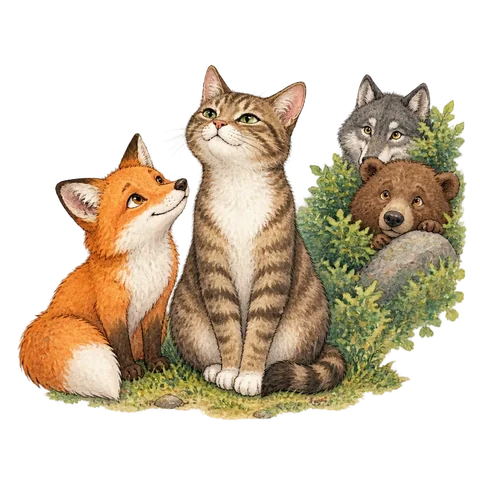
An abandoned cat introduces himself as an important official. The fox marries him and persuades a wolf and bear to bring offerings. The visitors mistake his ordinary appetite and sudden movements for signs of terrifying power.
Cultural note: Much of the humor comes from reputation and misunderstanding. The cat is not actually a mighty ruler; the forest animals supply that interpretation themselves.
Intermediate
— Traditional; collected by Alexander Afanasyev (Collector: 1826–1871), Afanasyev, Russian Folk Tales, no. 40 (Кот и лиса)
 Source note
The Crane and the Heron
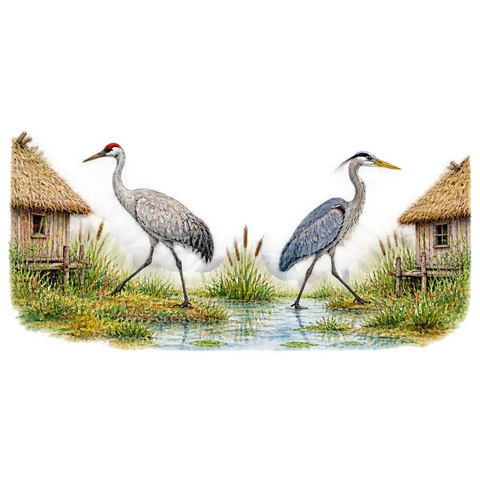
Жи́ли-бы́ли на боло́те жура́вль да ца́пля, постро́или себе́ по конца́м избу́шки.
Žíli-býli na bolóte žurávlʹ da cáplja, postróili sebé po koncám izbúški.
A crane and a heron once lived in a marsh and built huts at its opposite ends.
A crane proposes to a heron and receives an insulting refusal. She changes her mind, but now he rejects her. They continue taking turns approaching and refusing each other, unable to agree at the same time.
Cultural note: The circular ending makes wounded pride the joke. This is a proposal tale, not the hospitality story about the fox and crane.
Easy
— Traditional; collected by Alexander Afanasyev (Collector: 1826–1871), Afanasyev, Russian Folk Tales, no. 72 (Журавль и цапля)
 Source note
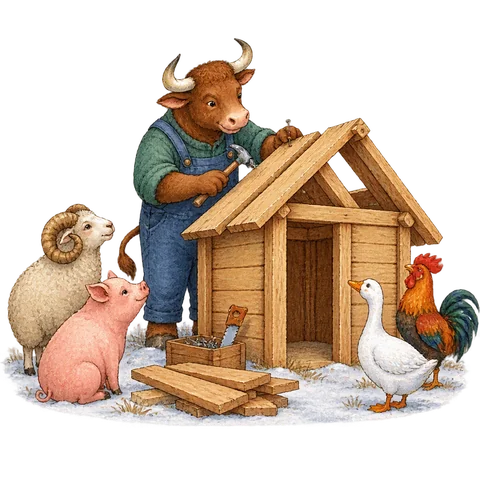
The Animals’ Winter Shelter
бык ле́сом; попада́ется ему́ навстре́чу бара́н.
Šël byk lésom; popadáetsja emú navstréču barán.
A bull was walking through the forest when a ram came toward him.
A bull builds a winter hut while a ram, pig, goose and rooster refuse to help. When the cold arrives, they pressure him into letting them inside. Later the household faces an attack by forest predators and defends its shelter.
Cultural note: The source does not say that everyone willingly helped build the house. Its defense is violent: the fox and wolf die while the bear escapes.
Intermediate
— Traditional; collected by Alexander Afanasyev (Collector: 1826–1871), Afanasyev, Russian Folk Tales, no. 64 (Зимовье зверей)
 Source note
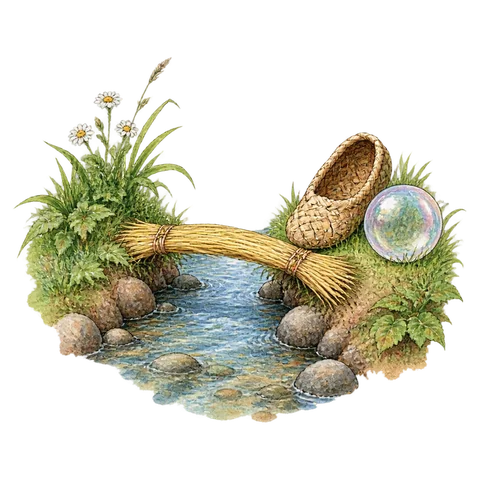
The Bubble, the Straw and the Bast Shoe
Жи́ли-бы́ли пузы́рь, соло́мина и ла́поть;
Žíli-býli puzýrʹ, solómina i lápotʹ;
Once there were a bubble, a straw and a bast shoe;
Three unlikely companions go to gather firewood and reach a river. The straw lies across it as a bridge, but breaks under the bast shoe. The bubble laughs at their misfortune until it bursts.
Cultural note: This brief object tale has an absurd, unhappy ending. A lapot is a shoe woven from bast, the fibrous inner bark of a tree.
Easy
— Traditional; collected by Alexander Afanasyev (Collector: 1826–1871), Afanasyev, Russian Folk Tales, no. 87 (Пузырь, соломинка и лапоть)
 Source note
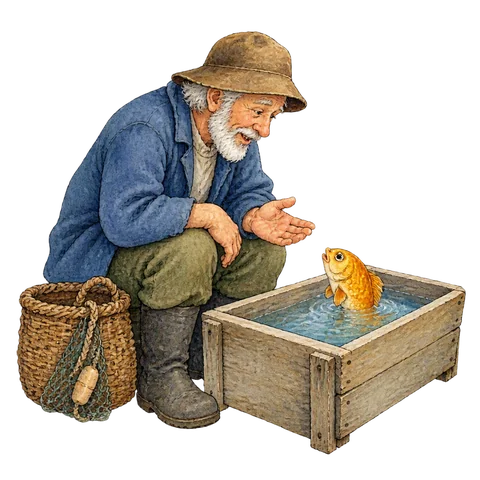
The Golden Fish
Мне ничего́ от тебя́ не на́добно: ступа́й гуля́й в !
Mne ničegó ot tebjá ne nádobno: stupáj guljáj v móre!
I need nothing from you: go and roam the sea!
An old fisherman releases a golden fish without asking for a reward. His wife sends him back with increasingly grand demands, moving from everyday needs to high status and power over the sea. The final demand leaves her with none of the gifts.
Cultural note: This is the collected prose tale numbered 75, not the text of Pushkin’s verse tale. Its shared motif does not make the wording or sequence of wishes identical.
Intermediate
— Traditional; collected by Alexander Afanasyev (Collector: 1826–1871), Afanasyev, Russian Folk Tales, no. 75 (Золотая рыбка)
 Source note
Explore these words: Animals (flashcards) · Directions & position (flashcards) · Nature & landscape (flashcards)
Put these words into context with a story at your level.
Read Russian storiesRead a Russian Tale in Three Passes
- Read the English summary and identify the main problem.
- Read one Russian paragraph aloud, using the acute marks before opening its translation.
- Listen again and retell the events with three verbs: went, saw and helped.
Russian fairy tales: frequently asked questions
Which Russian fairy tale is easiest for a beginner?
Start with Kolobok or The Fox and the Crane. Their A2 adaptations use repeated actions and a small cast. The Fly’s Little House also repeats a useful question-and-answer pattern.
Are these the original Russian fairy tales?
Each short quotation is checked in an identified Afanasyev version. The longer five A2 readings are new learner adaptations. They keep the selected plot but simplify or expand the wording.
Why do these versions differ from stories I remember?
Oral tales have many variants, and later books and cartoons change them again. Here the Fly’s Little House is no. 82 and Swan-Geese is no. 113, so their details should not be mixed with a different version.
Are all fifteen stories suitable for small children?
No. Some include death, cannibal threats, animal cruelty or abusive families. Even familiar animal tales can end violently. Read the cultural note and source before choosing one for a child.
Who is Baba Yaga?
Baba Yaga is a recurring supernatural figure in Slavic folklore. In these particular tales she can threaten a child, set tasks or control magical helpers. No single entry defines every version of the character.
Is The Golden Fish the poem by Pushkin?
No. This entry links to the prose tale numbered 75 in Afanasyev’s collection. It shares a wish-granting-fish motif with Pushkin’s verse tale but is not a quotation from that poem.
What do the marks above Russian vowels mean?
The acute mark shows stress: pronounce that syllable more strongly. Ё normally identifies a stressed vowel by itself. The romanization follows the same marked vowels so you can compare the two scripts.
How should I study one of the A2 retellings?
Try a paragraph before opening its English translation, listen while following the Cyrillic, and save a few useful words. Then summarize the action in your own simple Russian. The A2 label is an editorial learning target, not an exam certification.
Make these words part of your day
Explore Russian stories, listen along, and save vocabulary as you go.
Find a story at your levelSources and verification
English translations and examples were written for this guide. Source notes distinguish documented expressions, original practice sentences, and literary quotations. Literary excerpts retain the language of their original period.
- Afanasyev: Колобок, no. 36 — Opened Russian primary-text transcription, numbered variant 36. The selected quoted sentence and plot were checked in that variant; modern editorial notes and published translations were not copied.
- Afanasyev: Лиса и журавль, no. 33 — Opened Russian primary-text transcription, numbered variant 33. The selected quoted sentence and plot were checked in that variant; modern editorial notes and published translations were not copied.
- Afanasyev: Лиса, заяц и петух, no. 14 — Opened Russian primary-text transcription, numbered variant 14. The selected quoted sentence and plot were checked in that variant; modern editorial notes and published translations were not copied.
- Afanasyev: Терем мухи, no. 82 — Opened Russian primary-text transcription, numbered variant 82. The selected quoted sentence and plot were checked in that variant; modern editorial notes and published translations were not copied.
- Afanasyev: Гуси-лебеди, no. 113 — Opened Russian primary-text transcription, numbered variant 113. The selected quoted sentence and plot were checked in that variant; modern editorial notes and published translations were not copied.
- Afanasyev: Морозко, no. 95 — Opened Russian primary-text transcription, numbered variant 95. The selected quoted sentence and plot were checked in that variant; modern editorial notes and published translations were not copied.
- Afanasyev: Василиса Прекрасная, no. 104 — Opened Russian primary-text transcription, numbered variant 104. The selected quoted sentence and plot were checked in that variant; modern editorial notes and published translations were not copied.
- Afanasyev: Крошечка-Хаврошечка, no. 100 — Opened Russian primary-text transcription, numbered variant 100. The selected quoted sentence and plot were checked in that variant; modern editorial notes and published translations were not copied.
- Afanasyev: Баба-яга, no. 103 — Opened Russian primary-text transcription, numbered variant 103. The selected quoted sentence and plot were checked in that variant; modern editorial notes and published translations were not copied.
- Afanasyev: Лисичка-сестричка и волк, no. 1 — Opened Russian primary-text transcription, numbered variant 1. The selected quoted sentence and plot were checked in that variant; modern editorial notes and published translations were not copied.
- Afanasyev: Кот и лиса, no. 40 — Opened Russian primary-text transcription, numbered variant 40. The selected quoted sentence and plot were checked in that variant; modern editorial notes and published translations were not copied.
- Afanasyev: Журавль и цапля, no. 72 — Opened Russian primary-text transcription, numbered variant 72. The selected quoted sentence and plot were checked in that variant; modern editorial notes and published translations were not copied.
- Afanasyev: Зимовье зверей, no. 64 — Opened Russian primary-text transcription, numbered variant 64. The selected quoted sentence and plot were checked in that variant; modern editorial notes and published translations were not copied.
- Afanasyev: Пузырь, соломинка и лапоть, no. 87 — Opened Russian primary-text transcription, numbered variant 87. The selected quoted sentence and plot were checked in that variant; modern editorial notes and published translations were not copied.
- Afanasyev: Золотая рыбка, no. 75 — Opened Russian primary-text transcription, numbered variant 75. The selected quoted sentence and plot were checked in that variant; modern editorial notes and published translations were not copied.
- Afanasyev, Russian Folk Tales: collection index and numbered variants — Collection index used to distinguish numbered variants and to navigate to each selected primary text.
Source notes for all 15 entries
- Kolobok: The Runaway Bread Roll: Short source opening or key line checked in numbered variant 36. Stress marks are editorial; ё and drop-cap spacing are normalized. The English translation and summary are original. Any longer A2 text is a separately labeled new adaptation. [tale-kolobok]
- The Fox and the Crane: Short source opening or key line checked in numbered variant 33. Stress marks are editorial; ё and drop-cap spacing are normalized. The English translation and summary are original. Any longer A2 text is a separately labeled new adaptation. [tale-fox-crane]
- The Fox, the Hare and the Rooster: Short source opening or key line checked in numbered variant 14. Stress marks are editorial; ё and drop-cap spacing are normalized. The English translation and summary are original. Any longer A2 text is a separately labeled new adaptation. [tale-hare-house]
- The Fly’s Little House: Short source opening or key line checked in numbered variant 82. Stress marks are editorial; ё and drop-cap spacing are normalized. The English translation and summary are original. Any longer A2 text is a separately labeled new adaptation. [tale-terem]
- The Swan-Geese: Short source opening or key line checked in numbered variant 113. Stress marks are editorial; ё and drop-cap spacing are normalized. The English translation and summary are original. Any longer A2 text is a separately labeled new adaptation. [tale-geese]
- Morozko: Father Frost: Short source opening or key line checked in numbered variant 95. Stress marks are editorial; ё and drop-cap spacing are normalized. The English translation and summary are original. Any longer A2 text is a separately labeled new adaptation. [tale-morozko]
- Vasilisa the Beautiful: Short source opening or key line checked in numbered variant 104. Stress marks are editorial; ё and drop-cap spacing are normalized. The English translation and summary are original. Any longer A2 text is a separately labeled new adaptation. [tale-vasilisa]
- Little Khavroshechka: Short source opening or key line checked in numbered variant 100. Stress marks are editorial; ё and drop-cap spacing are normalized. The English translation and summary are original. Any longer A2 text is a separately labeled new adaptation. [tale-khavroshechka]
- Baba Yaga and the Helpful Cat: Short source opening or key line checked in numbered variant 103. Stress marks are editorial; ё and drop-cap spacing are normalized. The English translation and summary are original. Any longer A2 text is a separately labeled new adaptation. [tale-baba-yaga]
- Sister Fox and the Wolf: Short source opening or key line checked in numbered variant 1. Stress marks are editorial; ё and drop-cap spacing are normalized. The English translation and summary are original. Any longer A2 text is a separately labeled new adaptation. [tale-fox-wolf]
- The Cat and the Fox: Short source opening or key line checked in numbered variant 40. Stress marks are editorial; ё and drop-cap spacing are normalized. The English translation and summary are original. Any longer A2 text is a separately labeled new adaptation. [tale-cat-fox]
- The Crane and the Heron: Short source opening or key line checked in numbered variant 72. Stress marks are editorial; ё and drop-cap spacing are normalized. The English translation and summary are original. Any longer A2 text is a separately labeled new adaptation. [tale-crane-heron]
- The Animals’ Winter Shelter: Short source opening or key line checked in numbered variant 64. Stress marks are editorial; ё and drop-cap spacing are normalized. The English translation and summary are original. Any longer A2 text is a separately labeled new adaptation. [tale-winter-animals]
- The Bubble, the Straw and the Bast Shoe: Short source opening or key line checked in numbered variant 87. Stress marks are editorial; ё and drop-cap spacing are normalized. The English translation and summary are original. Any longer A2 text is a separately labeled new adaptation. [tale-bubble]
- The Golden Fish: Short source opening or key line checked in numbered variant 75. Stress marks are editorial; ё and drop-cap spacing are normalized. The English translation and summary are original. Any longer A2 text is a separately labeled new adaptation. [tale-goldfish]