
THE INKLINGO LANGUAGE GUIDES
10 Spanish Poems with English Translations
Read ten complete public-domain Spanish poems, from four-line love poems to Lorca’s children’s verse and Machado’s spring landscape. Each line has a fresh English translation, and each poem names its source and publication evidence.
Start here
Short Spanish Poems for Beginners
Begin with four compact poems whose repeated words make them approachable. Short does not mean that every metaphor is simple.

What Is Poetry?
Full public-domain text · Author died in 1870; documented publication in 1885, before 1930. The date is a verified publication or edition, not necessarily the first appearance. English translations are original.
Easy
— Gustavo Adolfo Bécquer (1836–1870), Rimas, XXI
The reply turns a definition into a declaration of love. The source transcription’s obvious typo proguntas is normalized to preguntas.
 Source note
For a Glance
Full public-domain text · Author died in 1870; documented publication in 1885, before 1930. The date is a verified publication or edition, not necessarily the first appearance. English translations are original.
Easy
— Gustavo Adolfo Bécquer (1836–1870), Rimas, XXIII
The escalating gifts make the four-line poem easy to follow. Diera has a hypothetical sense here: would give.
 Source note
Where Does Love Go?
Full public-domain text · Author died in 1870; documented publication in 1885, before 1930. The date is a verified publication or edition, not necessarily the first appearance. English translations are original.
Easy
— Gustavo Adolfo Bécquer (1836–1870), Rimas, XXXVIII
Air and water offer concrete comparisons before the unanswered question. The repeated son and van make useful reading practice.
 Source note
Everything Passes
Full public-domain text · Author died in 1939; documented publication in 1917, before 1930. The date is a verified publication or edition, not necessarily the first appearance. English translations are original.
Easy
— Antonio Machado (1875–1939), Campos de Castilla, Proverbios y cantares XLIV
The poem holds passing and remaining together rather than resolving the contradiction. The sea makes the idea of a permanent path impossible.
 Source note
Explore these words: Nature & landscape (flashcards) · Emotions & feelings (flashcards) · Question words
Put these words into context with a story at your level.
Read Spanish storiesFamous Spanish Poems About Life and Love
Machado and Darío move from walking and loving to the unsettling questions of conscious life.

Traveller, There Is No Path
Full public-domain text · Author died in 1939; documented publication in 1917, before 1930. The date is a verified publication or edition, not necessarily the first appearance. English translations are original.
Intermediate
— Antonio Machado (1875–1939), Campos de Castilla, Proverbios y cantares XXIX
The traveller makes a route through action. Huellas are footprints, senda is a track, and estelas are wakes: the shifting images matter as much as the familiar opening.
 Source note
Love, Always
Full public-domain text · Author died in 1916; documented publication in 1918, before 1930. The date is a verified publication or edition, not necessarily the first appearance. English translations are original.
Intermediate
— Rubén Darío (1867–1916), Cantos de vida y esperanza, “Amo, amas”, cited 1918 edition
Darío builds urgency by repeating the infinitive amar. The title conjugates love, while the poem expands the verb into a way of meeting the world.
 Source note
The Burden of Being
Full public-domain text · Author died in 1916; documented publication in 1905, before 1930. The date is a verified publication or edition, not necessarily the first appearance. English translations are original.
Hard
— Rubén Darío (1867–1916), Cantos de vida y esperanza, “Lo fatal”
An adult meditation on mortality, not a comforting children’s verse. The unusual line break after por leaves the reader suspended before what cannot be known.
 Source note
Explore these words: Emotions & feelings (flashcards) · Nature & landscape (flashcards) · Directions & position (flashcards)
Put these words into context with a story at your level.
Read Spanish storiesSpanish Poems for Kids and Shared Reading
These two poems belong to Lorca’s children’s section in Canciones. Their concrete images reward slow reading aloud.

The Seashell
Full public-domain text · Author died in 1936; documented publication in 1927, before 1930. The date is a verified publication or edition, not necessarily the first appearance. English translations are original.
Easy
— Federico García Lorca (1898–1936), Canciones, Canciones para niños, “Caracola”
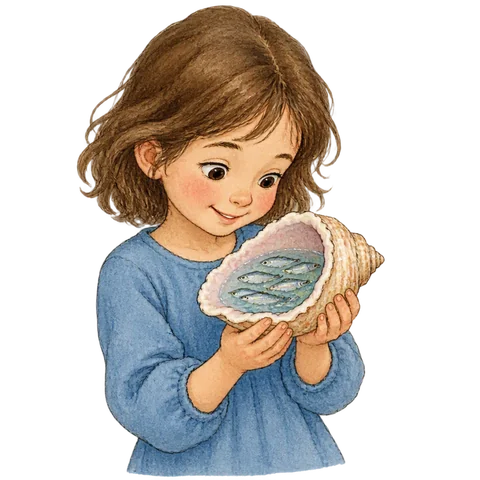
The shell brings an imagined sea into the speaker’s heart. A mar de mapa is a miniature, imagined sea rather than an ordinary physical sea.
 Source note
A Silly Song
Full public-domain text · Author died in 1936; documented publication in 1927, before 1930. The date is a verified publication or edition, not necessarily the first appearance. English translations are original.
Easy
— Federico García Lorca (1898–1936), Canciones, Canciones para niños, “Canción tonta”
A mother answers a child’s impossible wishes. The final wish turns the child into an embroidered image that can remain close. The transcription’s bórdarme is corrected to the imperative bórdame.
 Source note
Explore these words: Shapes, sizes & materials (flashcards) · Drinks (flashcards) · Music & dance (flashcards)
Put these words into context with a story at your level.
Read Spanish storiesA Spanish Spring Poem
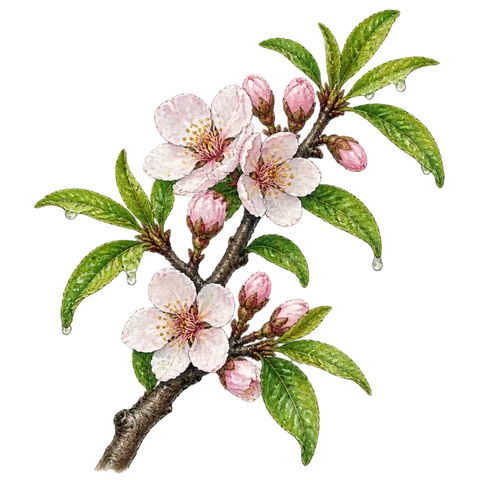
Fresh leaves, April rain and almond blossom become a way of thinking about memory.
Spring Was Kissing
Full public-domain text · Author died in 1939; documented publication in 1907, before 1930. The date is a verified publication or edition, not necessarily the first appearance. English translations are original.
Intermediate
— Antonio Machado (1875–1939), Soledades, galerías y otros poemas, LXXXV
Spring’s new growth contrasts with a youth the speaker feels he missed. The opening is gentle and concrete; the ending introduces regret and the wish expressed by quién plus the subjunctive.
 Source note
Explore these words: Weather (flashcards) · Seasons & celebrations (flashcards) · Plants & trees (flashcards)
Put these words into context with a story at your level.
Read Spanish storiesRead a Poem in Three Passes
- Listen once and notice the repeated sounds and images.
- Read line by line, checking the English only when a phrase blocks your understanding.
- Read the entire poem again, following its punctuation across line breaks.
Spanish poems: frequently asked questions
Which Spanish poems are easiest for beginners?
Bécquer’s four-line poems, Machado’s Everything Passes and Lorca’s Seashell are useful starting points. Their vocabulary is short, although the images can suggest more than one interpretation.
Are these poems from Spain or Latin America?
Bécquer, Machado and Lorca were Spanish. Rubén Darío was Nicaraguan and wrote within a Spanish-language literary world that crossed national borders.
Which Spanish poems are suitable for children?
The Seashell and A Silly Song come from Lorca’s children’s section in Canciones. Read them together and let children describe the images before discussing abstract meanings.
Are the English translations literal?
They aim to make each Spanish line understandable while preserving its image. They do not attempt to copy the original rhyme or meter, and they are newly written translations.
Why are some short lines split across several rows?
The author’s line breaks shape rhythm and expectation. A sentence can continue into the next line, so punctuation is a better guide to pauses than the edge of a row.
Are the complete poems in the public domain?
Each full poem meets this project’s two requirements: its author died before 1956 and the work appeared in print before 1930. The publication note under each poem identifies the supporting edition; modern editorial commentary and published translations have not been copied.
What is the difference between a quote and a poem?
A quote isolates a short thought. This page restores complete poetic units and their line-by-line movement. For short shareable lines grouped by theme, use the Spanish quotes guide.
How can I learn vocabulary from Spanish poetry?
Start with concrete words such as sea, tree, stone, water and pillow. Then notice the verbs attached to them; a metaphor often comes from giving an ordinary object an unexpected action.
Make these words part of your day
Explore Spanish stories, listen along, and save vocabulary as you go.
Find a story at your levelSources and verification
English translations and examples were written for this guide. Source notes distinguish documented expressions, original practice sentences, and literary quotations. Literary excerpts retain the language of their original period.
- Biblioteca Nacional de España: Canciones, first edition Málaga, Litoral, 1927 — National-library edition record establishes 1927 publication. The displayed composition range 1921–1924 is not substituted for publication date.
- UNED: Canciones, table of contents — Pages1–2 place Caracola and Canción tonta in the collection’s Canciones para niños section. Modern discography is not reproduced.
- Cervantes Virtual: Páginas escogidas, 1917 edition record — Bibliographic record of the 1917 Calleja edition, including Soledades and Proverbios y cantares.
- Cervantes Virtual: Proverbios y cantares, textual chronology — Scholarly chronology distinguishes the 1912 sequence from its 1917 expansion. We conservatively cite 1917 for the complete selected numbered pieces.
- Gustavo Adolfo Bécquer, Rimas, XXI — Primary original Spanish poem. Modern punctuation/orthography and original English line translations; no published translation copied.
- Gustavo Adolfo Bécquer, Rimas, XXIII — Primary original Spanish poem. Modern punctuation/orthography and original English line translations; no published translation copied.
- Gustavo Adolfo Bécquer, Rimas, XXXVIII — Primary original Spanish poem. Modern punctuation/orthography and original English line translations; no published translation copied.
- Antonio Machado, Campos de Castilla, Proverbios y cantares XLIV — Primary original Spanish poem. Modern punctuation/orthography and original English line translations; no published translation copied.
- Antonio Machado, Campos de Castilla, Proverbios y cantares XXIX — Primary original Spanish poem. Modern punctuation/orthography and original English line translations; no published translation copied.
- Rubén Darío, Cantos de vida y esperanza, “Amo, amas”, cited 1918 edition — Primary original Spanish poem. Modern punctuation/orthography and original English line translations; no published translation copied.
- Rubén Darío, Cantos de vida y esperanza, “Lo fatal” — Primary original Spanish poem. Modern punctuation/orthography and original English line translations; no published translation copied.
- Federico García Lorca, Canciones, Canciones para niños, “Caracola” — Primary original Spanish poem. Modern punctuation/orthography and original English line translations; no published translation copied.
- Federico García Lorca, Canciones, Canciones para niños, “Canción tonta” — Primary original Spanish poem. Modern punctuation/orthography and original English line translations; no published translation copied.
- Antonio Machado, Soledades, galerías y otros poemas, LXXXV — Primary original Spanish poem. Modern punctuation/orthography and original English line translations; no published translation copied.
- Cervantes Virtual: Soledades, 1907 edition and author dates — National-library reproduction record: Madrid, Librería Pueyo,1907; author1875–1939.
- Cervantes Virtual: Cantos de vida y esperanza, 1905 original text — Primary transcription explicitly based on the1905 Madrid edition; includes Lo fatal and Amo, amas.
- Cervantes Virtual: Darío1867–1916 and1905 edition record — Library authority dates and publication record.
- Biblioteca Nacional: Bécquer1836–1870 — Author dates and publication history of Rimas, including the1871 posthumous edition.
- Biblioteca Nacional: Federico García Lorca — National-library author biography,1898–1936.
- University of Granada: Lorca complete poetry transcription — Independent original-text witness confirms Bórdame en tu almohada in Canción tonta.
- Cervantes Virtual: Rima XXI original text — Independent witness confirms preguntas, correcting the obvious Wikisource transcription typo proguntas.
Source notes for all 10 entries
- What Is Poetry?: Complete original poem. The reply turns a definition into a declaration of love. The source transcription’s obvious typo proguntas is normalized to preguntas. [becquer-xxi] [becquer-dates] [becquer-transcription]
- For a Glance: Complete original poem. The escalating gifts make the four-line poem easy to follow. Diera has a hypothetical sense here: would give. [becquer-xxiii] [becquer-dates]
- Where Does Love Go?: Complete original poem. Air and water offer concrete comparisons before the unanswered question. The repeated son and van make useful reading practice. [becquer-xxxviii] [becquer-dates]
- Everything Passes: Complete original poem. The poem holds passing and remaining together rather than resolving the contradiction. The sea makes the idea of a permanent path impossible. [machado-xliv] [machado-1917] [machado-history]
- Traveller, There Is No Path: Complete original poem. The traveller makes a route through action. Huellas are footprints, senda is a track, and estelas are wakes: the shifting images matter as much as the familiar opening. [machado-xxix] [machado-1917] [machado-history]
- Love, Always: Complete original poem. Darío builds urgency by repeating the infinitive amar. The title conjugates love, while the poem expands the verb into a way of meeting the world. [dario-amo] [dario-1905] [dario-dates]
- The Burden of Being: Complete original poem. An adult meditation on mortality, not a comforting children’s verse. The unusual line break after por leaves the reader suspended before what cannot be known. [dario-fatal] [dario-1905] [dario-dates]
- The Seashell: Complete original poem. The shell brings an imagined sea into the speaker’s heart. A mar de mapa is a miniature, imagined sea rather than an ordinary physical sea. [lorca-caracola] [lorca-1927] [lorca-contents] [lorca-dates]
- A Silly Song: Complete original poem. A mother answers a child’s impossible wishes. The final wish turns the child into an embroidered image that can remain close. The transcription’s bórdarme is corrected to the imperative bórdame. [lorca-tonta] [lorca-1927] [lorca-contents] [lorca-dates] [lorca-transcription]
- Spring Was Kissing: Complete original poem. Spring’s new growth contrasts with a youth the speaker feels he missed. The opening is gentle and concrete; the ending introduces regret and the wish expressed by quién plus the subjunctive. [machado-primavera] [machado-1917] [soledades-1907]