
THE INKLINGO LANGUAGE GUIDES
15 Spanish Fairy Tales and Folk Tales
Discover ten tales collected in Spain by Fernán Caballero and five South American animal stories by Horacio Quiroga. Five have complete, newly written A2 adaptations with paragraph translations. The old source lines remain clearly separate from those graded retellings.
Start here
- The Three WishesThere was an elderly married couple who, though poor, had spent their whole lives quite happily working and tending their little property.
- The Little Friar GoblinOnce there were three little sisters who earned their living by kneading a small measure of flour at night.
- The Goat, the Wasp and the CarlancoOnce upon a time there was a very respectable goat who had brought up three little goats carefully and kept them in her home.
- The Giant TortoiseHe lived alone in the forest and cooked for himself.
- The Lazy BeeSo she was a lazy bee.
Spanish Fairy Tales for Beginners: Five A2 Retellings
Start with these five complete adaptations. Each keeps the main sequence while using shorter sentences and a limited cast.
The Three Wishes
Había un , que aunque pobre, toda su vida la había pasado muy bien y cuidando de su pequeña hacienda.
There was an elderly married couple who, though poor, had spent their whole lives quite happily working and tending their little property.
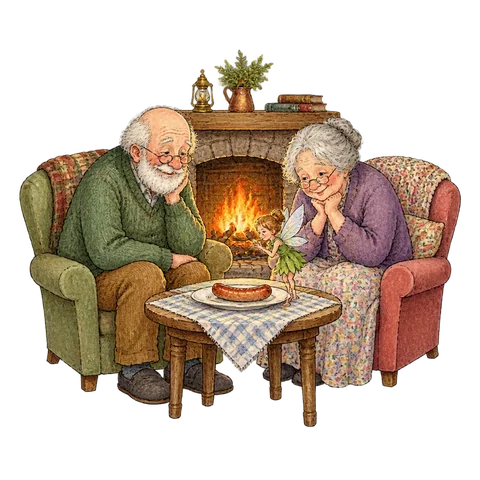
A fairy grants an elderly couple three wishes. A careless wish produces a sausage, an angry second wish attaches it to the wife’s nose, and the last wish must undo the damage.
Cultural note: The joke warns against envy and speaking in anger. Caballero’s version gives each spouse one wish and reserves the third for their joint decision.
An A2 retelling to read and listen to
New Codex-authored A2 adaptation of the cited public-domain plot. Added scene-setting and simplified dialogue are part of this adaptation, not quotations from the original.
Un hombre y su mujer viven en una casa pequeña. Son mayores y trabajan mucho. Tienen comida, un poco de tierra y un fuego para las noches frías. Pero no están . Miran las casas de sus vecinos y siempre quieren algo más. Una noche a hablar de todo lo que les falta.
De pronto, una muy pequeña baja por la . Lleva una y parece hecha de . Es el hada Fortunata. Les ofrece tres : uno para la , otro para el y un último para los dos. Para el último, tienen que estar de acuerdo. El hada vuelve la noche siguiente.
Los dos hablan de una casa nueva y de fuertes. Tienen tantas que no pueden elegir. Entonces el hombre recuerda las morcillas de un vecino. Su mujer tiene hambre y dice que quiere una para la . En ese momento aparece una gran morcilla sobre el fuego. Su primer ya está gastado.
El se enfada mucho. Quiere decir algo terrible y que la morcilla se pegue a la nariz de su mujer. Eso ocurre . Ahora ella está también. Tira de la morcilla, pero no puede quitarla. Ya no le interesa una casa grande ni una llena de oro. Sólo quiere su nariz de antes.
Cuando vuelve Fortunata, los dos ya saben qué pedir. Su último es quitar la morcilla. Así pierden la oportunidad de hacerse ricos, pero recuperan su vida normal. El hada les hace pensar en lo que ya tenían. Una palabra dicha con y otra dicha con han gastado casi toda su suerte.
Easy
— Fernán Caballero (1796–1877), Los deseos
 Source note
The Little Friar Goblin
Había una vez tres hermanitas que se mantenían amasando de noche una faneguita de .
Once there were three little sisters who earned their living by kneading a small measure of flour at night.
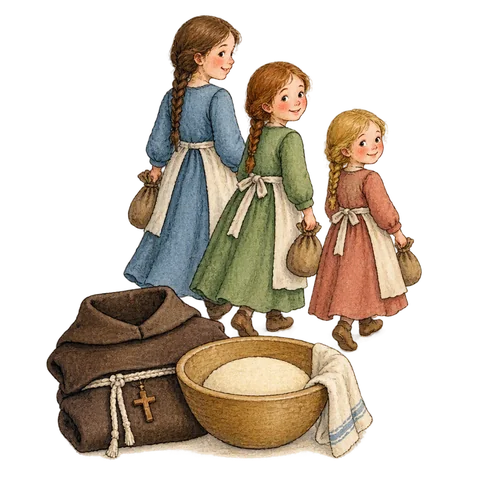
Three sisters discover that a tiny goblin in a worn friar’s habit secretly kneads their bread. They give him new clothes in gratitude, but the newly dressed helper leaves his baking behind.
Cultural note: The source’s narrator criticizes help that lasts only until a reward arrives. Other household-spirit traditions interpret the gift differently; this summary follows Caballero.
An A2 retelling to read and listen to
New Codex-authored A2 adaptation of the cited public-domain plot. Added scene-setting and simplified dialogue are part of this adaptation, not quotations from the original.
Tres viven juntas y hacen para ganar . No tienen un trabajo . Por la noche preparan la y el agua. Después tienen que trabajar la masa con las manos. Cuando los demás todavía duermen, ellas ya están en la cocina. El debe estar listo para entrar en el muy .
Una mañana encuentran una sorpresa. La masa está preparada y los panes esperan junto al . Las se miran. Ninguna ha hecho el trabajo. ¿Ha entrado alguien en la casa? ¿Quién puede ayudarlas a esa hora? Al día siguiente pasa lo mismo, y también al otro. Cada noche alguien trabaja mientras ellas .
Las tres quieren conocer a su . Una noche no se van a la . Se esconden en un lugar de la cocina y esperan en silencio. Al cabo de un aparece un duende muy pequeño. Lleva ropa de fraile, pero su ropa es y está rota. Se acerca a la y a preparar el .
Las están agradecidas y quieren darle un . Deciden hacerle ropa nueva. Trabajan con cuidado, porque todo debe ser pequeño. Cuando terminan, cuelgan el en la cocina. Esa noche vuelven a esconderse. Esperan ver al duende feliz y piensan que al día siguiente tendrán y un amigo con un traje mejor.
El duende llega, ve la ropa y se la pone enseguida. Está muy contento con su aspecto. Sin embargo, ya no quiere hacer . Dice que un fraile con ropa nueva no tiene que trabajar como y se marcha. Las se quedan mirando la puerta. Su ha cambiado la noche de una forma que no esperaban.
Easy
— Fernán Caballero (1796–1877), El duendecillo fraile
 Source note
The Goat, the Wasp and the Carlanco
Era y una , muy mujer de bien, que tenía tres chivitas que había criado muy bien, y metiditas en su .
Once upon a time there was a very respectable goat who had brought up three little goats carefully and kept them in her home.
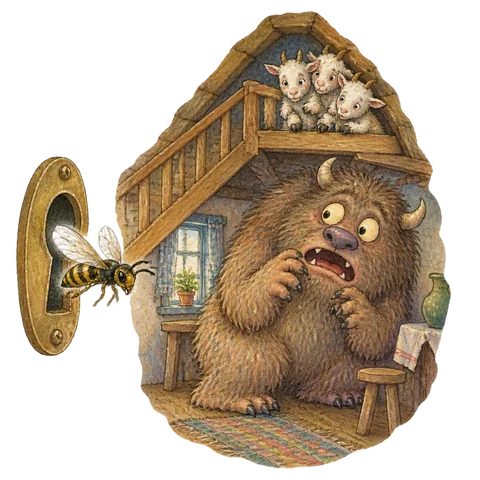
A goat rescues a drowning wasp. Later, the threatening Carlanco tricks the kids into opening their door. They hide upstairs, and the grateful wasp drives the intruder out.
Cultural note: A small helper can repay a large kindness. The Carlanco is a frightening folkloric intruder; this version ends with the family safe.
An A2 retelling to read and listen to
New Codex-authored A2 adaptation of the cited public-domain plot. Added scene-setting and simplified dialogue are part of this adaptation, not quotations from the original.
Una vive con sus tres en una casa del monte. Un día encuentra una avispa en un arroyo. El agua se la lleva y la avispa no puede salir. La acerca una rama y el pequeño sube a ella. La avispa le da las gracias y le ofrece ayuda si algún día la .
Poco después, la tiene que salir a buscar . Antes de irse, habla con sus . Deben cerrar bien la puerta y no abrir a nadie. Por allí vive el Carlanco, un ser grande que da mucho miedo. La les enseña unas palabras para reconocerla. Sólo pueden abrir cuando oyen esas palabras y su voz.
El Carlanco llega a la casa y pide entrar. Su voz es fuerte y las cabritas saben que no es su . No abren. Al día siguiente, él se esconde y escucha a la . Ahora conoce las palabras. Cuando ella se aleja, vuelve a la puerta e hablar como ella. Esta vez las pequeñas le creen.
Al verlo dentro, las tres corren hasta una escalera. Suben al piso de arriba y retiran la escalera. El Carlanco no puede alcanzarlas, pero tampoco pueden bajar. Cuando vuelve la , sus hijas le cuentan lo que pasa desde arriba. La deja la leña y corre a buscar a su amiga, la avispa del arroyo.
La avispa recuerda la buena acción de la y va con ella. Es tan pequeña que puede entrar por el agujero de la llave. Dentro, a picar al Carlanco en la cara. Él no sabe cómo defenderse y sale corriendo. Las cabritas pueden bajar por fin. La está a salvo gracias a una amiga diminuta.
Easy
— Fernán Caballero (1796–1877), El Carlanco
 Source note
The Giant Tortoise
Vivía en el , y él mismo se cocinaba.
He lived alone in the forest and cooked for himself.
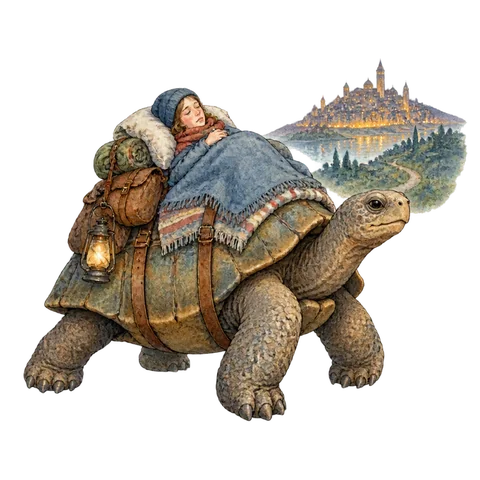
A hunter saves a badly injured tortoise. When he later becomes gravely ill, she carries him across the wilderness to Buenos Aires. A mouse helps her recognize the city just when she is ready to give up.
Cultural note: Quiroga’s literary animal tale links gratitude with patient action. It belongs to his 1918 South American collection, rather than an anonymous Spanish folk tradition.
An A2 retelling to read and listen to
New Codex-authored A2 adaptation of the cited public-domain plot. Added scene-setting and simplified dialogue are part of this adaptation, not quotations from the original.
Un hombre de Buenos Aires está enfermo. Un amigo le ayuda a irse al monte para recuperar las fuerzas. vive solo, busca comida y duerme bajo los . Poco a poco se encuentra mejor. Un día ve a un que ataca a una tortuga . El hombre dispara al y se acerca a la tortuga.
Tiene hambre y primero piensa en comérsela. Pero la tortuga está herida y le da mucha pena. La lleva hasta su refugio, limpia sus y le pone . Durante varios días la . Al final, el puede moverse otra vez. El hombre no sabe que pronto él también va a la ayuda de alguien.
El cazador vuelve a enfermar. Tiene mucha fiebre y no puede levantarse. La tortuga le trae agua y comida, pero eso no basta. Él dice que los de Buenos Aires. Entonces ella decide llevarlo . Lo coloca con cuidado sobre su espalda y lo sujeta con plantas largas y fuertes para que no se caiga.
El viaje es muy largo. La tortuga cruza y , de día y de noche y se detiene para darle agua. Cada vez tiene menos fuerzas. Una noche ve una luz , pero ya casi no puede seguir. Un le que esa luz es la . ¡Han llegado! La noticia le da fuerzas para continuar.
La tortuga lleva al hombre hasta su amigo, el del . recibe y se cura. Cuando quién lo ha salvado, quiere estar siempre cerca de la tortuga. El le da un en el . Desde entonces, el hombre la visita cada tarde. Los dos amigos no olvidan lo que han hecho el uno por el otro.
Easy
— Horacio Quiroga (1878–1937), La tortuga gigante
 Source note
The Lazy Bee
Era, pues, una haragana.
So she was a lazy bee.
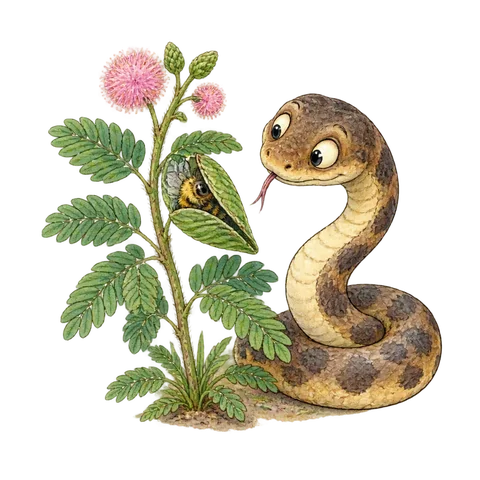
A bee enjoys the flowers but contributes no honey to her hive. Shut out on a stormy evening, she escapes a snake by hiding inside a leaf that closes when touched. The experience changes her attitude toward shared work.
Cultural note: The source distinguishes being busy from helping the community. Its plant trick is a fantastical story device built around the sensitive plant.
An A2 retelling to read and listen to
New Codex-authored A2 adaptation of the cited public-domain plot. Added scene-setting and simplified dialogue are part of this adaptation, not quotations from the original.
En una colmena vive una que no quiere trabajar. Le encanta volar entre las y beber su . Mientras las otras abejas preparan comida para toda la , ella pasa el día divirtiéndose. Por la noche vuelve a la colmena para . Las abejas de la puerta le dicen varias veces que tiene que ayudar.
La promete cambiar, pero al día siguiente hace lo mismo. Una tarde, las guardianas no la dejan entrar. Hace frío y pronto va a llover. Ella pide ayuda, pero la puerta sigue cerrada. Tiene que buscar otro lugar para pasar la noche. cae en una donde vive una culebra que quiere comérsela.
La ganar tiempo. Las dos deciden hacer una prueba de . La culebra hace girar una pequeña pieza de un con la . La no puede hacer eso. Sin embargo, ha visto una planta en la : cuando algo toca sus hojas, las hojas se cierran. Ahora tiene una .
Dice que puede sin salir de la . Pide a la culebra que se vuelva y cuente hasta tres. Entonces entra en una hoja, que se cierra sobre ella. La culebra busca por todas partes y no la encuentra. Al final acepta la derrota y promete no hacerle daño. Sólo entonces la sale de su .
La noche es larga, fría y llena de . La piensa en su casa y en el trabajo de sus compañeras. A la mañana siguiente vuelve a la colmena, y esta vez la dejan entrar. Desde ese día trabaja con las demás. Ya entiende que una casa segura y comida para todos no aparecen solas: alguien tiene que prepararlas.
Easy
— Horacio Quiroga (1878–1937), La abeja haragana
 Source note
Explore these words: Animals (flashcards) · Family & relationships (flashcards) · Food & cooking (flashcards)
Put these words into context with a story at your level.
Read Spanish storiesTraditional Fairy Tales Collected in Spain
These are Caballero’s particular versions. Familiar motifs travel across languages, and the details do not always match a modern bedtime adaptation.
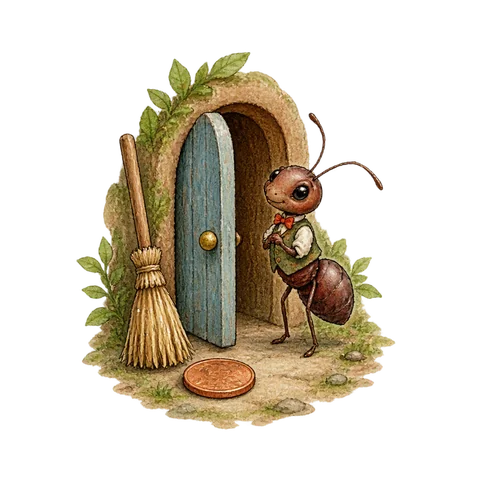
The Little Ant
Un que estaba barriendo la puerta de su casa, se halló un ochavito.
One day, while sweeping her doorway, she found a small copper coin.
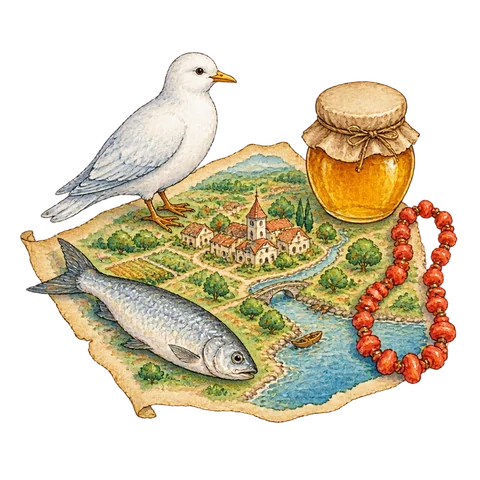
An ant uses a found coin to dress up, turns away noisy suitors and marries the gentle Ratonpérez. He disobeys her cooking instruction and drowns in the pot; her grief sets off a chain of mourning among neighbors and objects.
Cultural note: This is a cumulative tale with a sad ending, not a tooth-fairy story about every later Ratón Pérez. Adults may want to read the full source before sharing it with young children.
Intermediate
— Fernán Caballero (1796–1877), La hormiguita
 Source note
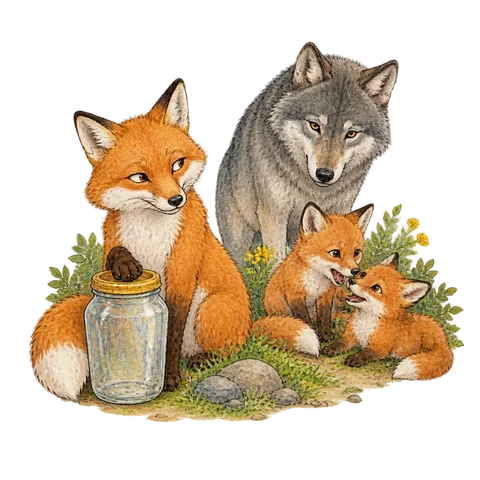
The Foolish Wolf and the Clever Fox
Había una vez una zorra que tenía dos zorritas de corta edad.
Once there was a fox who had two young cubs.
A fox asks a wolf to mind her cubs while she supposedly attends christenings. Instead, she steals his honey, invents revealing names for the imaginary babies, and finally shifts the blame to him.
Cultural note: The fox is a trickster, not a reliable moral example. The invented baby names in the original joke track how much honey she has eaten.
Intermediate
— Fernán Caballero (1796–1877), El lobo bobo y la zorra astuta
 Source note
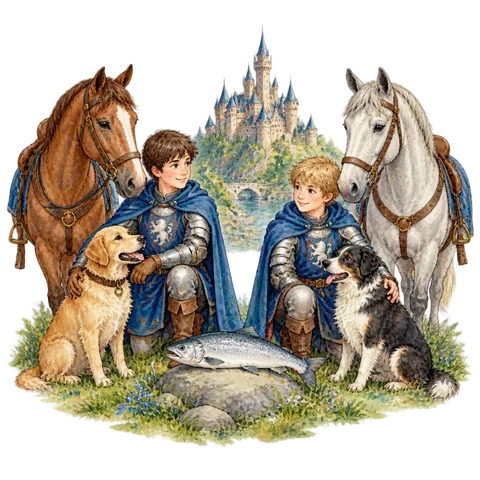
The Knights of the Fish
Érase vez y vez un pobre zapatero remendón, que no ganaba nada en su oficio, y así determinó una y meterse a .
Once there was a poor cobbler who earned nothing from his trade, so he decided to buy a net and become a fisherman.
A talking fish brings about the births of twin brothers with matching animal companions and swords. One brother defeats a dragon but falls into an enchanted castle’s trap; the other follows and restores him and its other victims to life.
Cultural note: The tale combines miraculous birth, dragon fighting and the loyal twin motif. The original includes violent deaths and revivals; the guide’s summary is deliberately brief.
Hard
— Fernán Caballero (1796–1877), Los caballeros del pez
 Source note
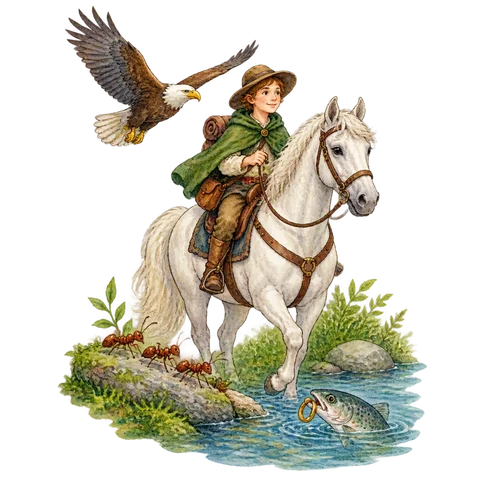
Bella Flor and the White Horse
Había una vez un padre que tenía dos hijos;
Once there was a father who had two sons;
José spends his recovered inheritance helping a sick stranger. A mysterious white horse then helps him complete a king’s impossible demands. Animals José has helped return the favor, and the horse finally reveals a debt of gratitude of its own.
Cultural note: This is a grateful-helper tale. Its cruel king and forced courtship reflect the old source; they are not offered as models of acceptable behavior.
Hard
— Fernán Caballero (1796–1877), Bella Flor
 Source note
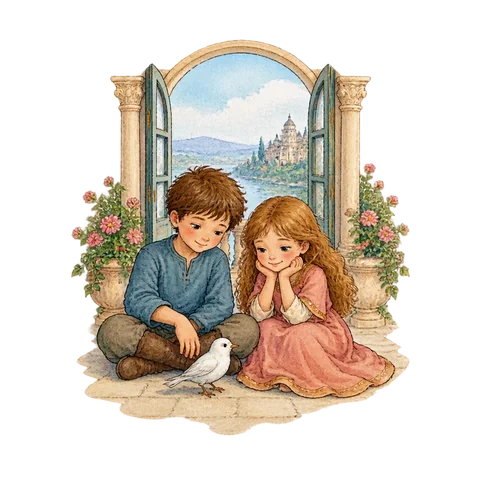
The Bird of Truth
Érase vez y vez un muy pobre, que vivía en una chocita en la orilla de un ,
Once there was a very poor fisherman who lived in a little hut on the bank of a river,
A fisherman raises abandoned royal twins. The boy learns the language of birds and seeks the small white Bird of Truth through an enchanted castle. Its testimony finally exposes the plot that separated the children from their parents.
Cultural note: The quiet white bird contrasts with louder, showier impostors. This Spanish collected version gives the quest to the brother, so it should not be silently merged with another variant.
Hard
— Fernán Caballero (1796–1877), El pájaro de la verdad
 Source note
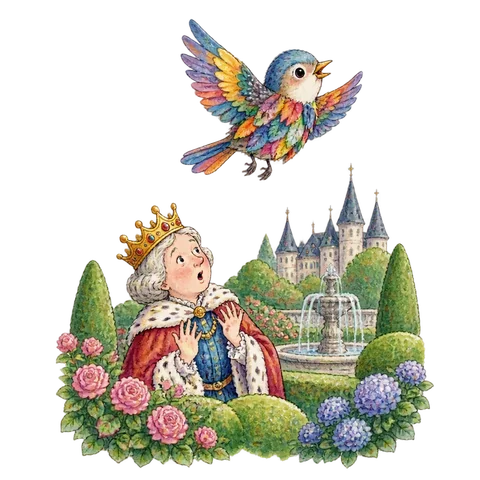
The Mischievous Little Bird
Había vez y vez un pajarito, que se fue a un sastre, y le mandó que le hiciese un vestidito de lana.
Once there was a little bird who went to a tailor and ordered a little woolen suit.
A bird steals fine clothes, mocks a king and survives being swallowed by him. After escaping, it borrows colorful feathers from other birds and resumes its teasing before flying beyond the king’s reach.
Cultural note: This extravagant trickster tale breaks ordinary physical rules. Its hero is amusing and dishonest; it is not a lesson in paying a tailor fairly.
Intermediate
— Fernán Caballero (1796–1877), El pícaro pajarillo
 Source note
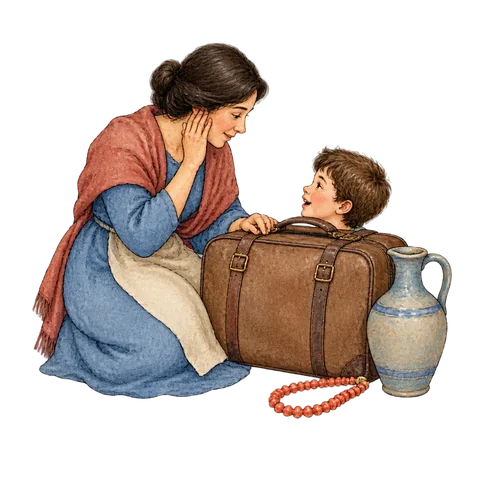
The Singing Bag
Un le dijo que fuera por un cantarito de a la fuente, que estaba fuera del lugar.
One day she told her to fetch a small jug of water from the spring outside the village.
A girl returns to a spring for her forgotten necklace and is trapped in a bag by a traveling beggar. Her mother recognizes her voice when he exhibits the supposedly singing bag and rescues her while he sleeps.
Cultural note: This rescue tale includes abduction and a violent punishment in the original. Its recognizable repeated song is part of the old narrative, but no song lyrics are reproduced here.
Hard
— Fernán Caballero (1796–1877), El zurrón que cantaba
 Source note
Explore these words: Time & dates (flashcards) · Jobs & work (flashcards) · Shopping (flashcards)
Put these words into context with a story at your level.
Read Spanish storiesLatin American Animal Tales in Spanish
Quiroga’s 1918 stories draw on the rivers and forests of South America. Their humor often sits beside danger, and their animals do not always behave gently.
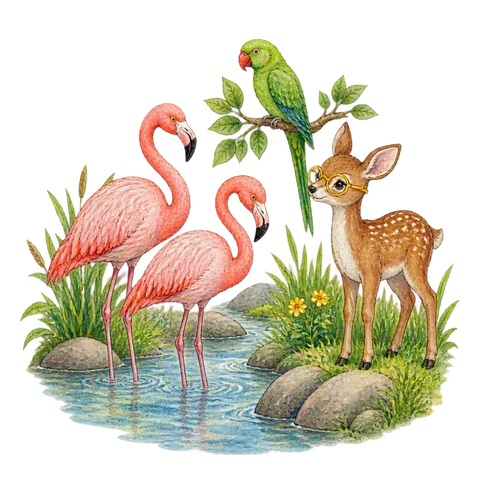
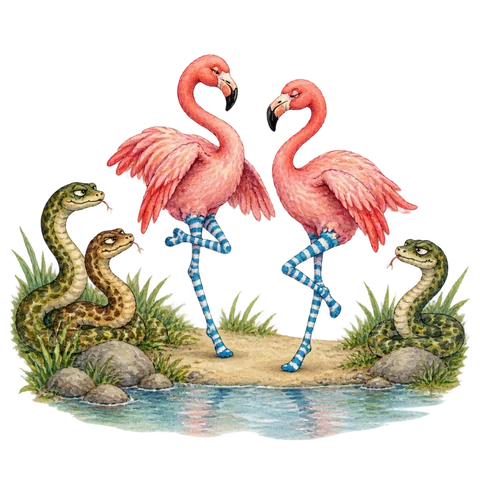
The Flamingos’ Stockings
Invitaron a las ranas y los sapos, a los flamencos, y a los yacarés y los pescados.
They invited the frogs and toads, the flamingos, the caimans and the fish.
Flamingos want splendid red, white and black stockings for a snake dance. An owl supplies skins from coral snakes; the guests discover the deception and bite the birds’ legs. The tale offers a fanciful explanation for flamingos standing in water.
Cultural note: This is Quiroga’s authored origin tale, not a scientific account of flamingo color or behavior. Its comedy turns painful, so it is better discussed with children than treated as harmless slapstick.
Intermediate
— Horacio Quiroga (1878–1937), Las medias de los flamencos
 Source note
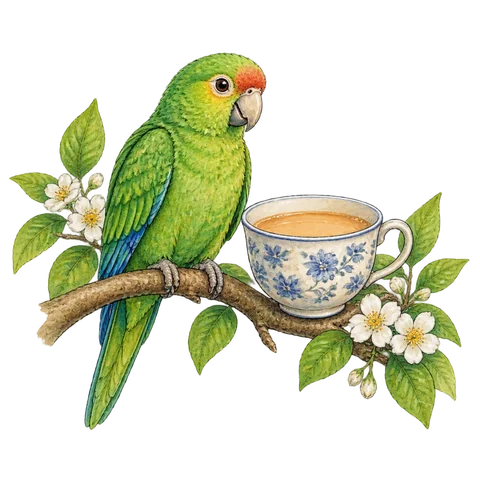
The Featherless Parrot
Se Pedrito.
His name was Pedrito.
A wounded parrot becomes a family’s talkative companion. A jaguar tricks and attacks him, leaving him without feathers; after recovering, the bird helps his owner find the predator and takes his revenge.
Cultural note: The regional word tigre in this South American setting refers to a jaguar. The source includes hunting and revenge, even though its repeated household phrases sound playful.
Intermediate
— Horacio Quiroga (1878–1937), El loro pelado
 Source note
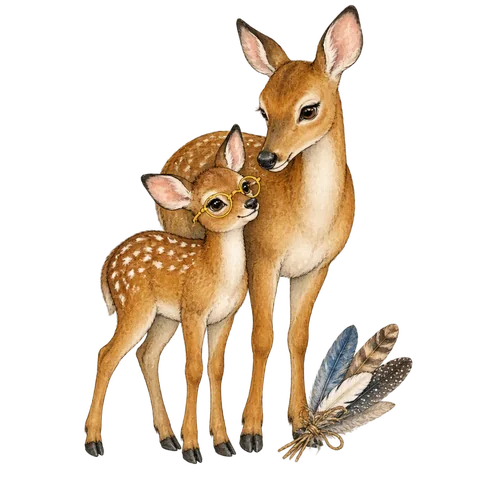
The Blind Little Doe
, ! veo todo!
I can see, Mama! I can see everything now!
A young doe damages her eyes after disturbing stinging bees. Her mother seeks help from a hunter through an animal friend; the doe recovers and later brings him a small gift to express her thanks.
Cultural note: The tale develops trust across an expected animal–hunter boundary. Its treatment details belong to fiction and are not practical eye-care instructions.
Intermediate
— Horacio Quiroga (1878–1937), La gama ciega
 Source note
Explore these words: Family & relationships (flashcards) · Time & dates (flashcards)
Put these words into context with a story at your level.
Read Spanish storiesRead a Tale in Three Passes
- Read the English summary and predict the main problem.
- Try one Spanish paragraph before opening its translation.
- Listen again while following the Spanish, then retell the action in three simple sentences.
Spanish fairy tales: frequently asked questions
Which Spanish fairy tale should a beginner read first?
Try The Three Wishes or The Little Friar Goblin. Their five-paragraph A2 retellings have a small cast, a clear problem and an ending you can summarize in one sentence.
Are all these tales originally from Spain?
No. Ten are Spanish collected versions by Fernán Caballero. Five are authored South American animal stories by the Uruguayan writer Horacio Quiroga. Their origin is stated on each entry.
Are the full retellings the original texts?
No. The short opening or key line is quoted from the source. The longer A2 retelling is a new adaptation written for learners, with new English translations.
What does A2 mean here?
It is an editorial reading target, not a certified exam rating. The adaptations use short paragraphs and frequent vocabulary, while a few story words such as fairy, hive or tortoise still need context.
Are these Spanish stories suitable for children?
Some are, with adult guidance. Traditional stories can include death, abduction or violence, and Quiroga’s animals face real danger. Read the entry’s cultural note before choosing a source for a child.
Why does a South American story mention a tiger?
In Quiroga’s regional usage, tigre refers to the jaguar. The English summaries and graded adaptations use jaguar to preserve the intended animal.
Which Spanish accent does the audio use?
The guide consistently uses es-ES, Spanish from Spain. That pronunciation setting does not change the South American origin of Quiroga’s stories.
How can I use these tales to build vocabulary?
Open useful words in a paragraph, save a few you need, then practice the section’s word set. Try a related Inklingo story to meet the words again in a different context.
Make these words part of your day
Explore Spanish stories, listen along, and save vocabulary as you go.
Find a story at your levelSources and verification
English translations and examples were written for this guide. Source notes distinguish documented expressions, original practice sentences, and literary quotations. Literary excerpts retain the language of their original period.
- Fernán Caballero: Los deseos — Opened original-language text. For Quiroga, the linked transcription is tied to the 1918 edition; Caballero’s text is in the collection indexed as the 1921 edition. Used for the quoted line and plot, not for a borrowed English translation.
- Fernán Caballero: El duendecillo fraile — Opened original-language text. For Quiroga, the linked transcription is tied to the 1918 edition; Caballero’s text is in the collection indexed as the 1921 edition. Used for the quoted line and plot, not for a borrowed English translation.
- Fernán Caballero: El Carlanco — Opened original-language text. For Quiroga, the linked transcription is tied to the 1918 edition; Caballero’s text is in the collection indexed as the 1921 edition. Used for the quoted line and plot, not for a borrowed English translation.
- Horacio Quiroga: La tortuga gigante — Opened original-language text. For Quiroga, the linked transcription is tied to the 1918 edition; Caballero’s text is in the collection indexed as the 1921 edition. Used for the quoted line and plot, not for a borrowed English translation.
- Horacio Quiroga: La abeja haragana — Opened original-language text. For Quiroga, the linked transcription is tied to the 1918 edition; Caballero’s text is in the collection indexed as the 1921 edition. Used for the quoted line and plot, not for a borrowed English translation.
- Fernán Caballero: La hormiguita — Opened original-language text. For Quiroga, the linked transcription is tied to the 1918 edition; Caballero’s text is in the collection indexed as the 1921 edition. Used for the quoted line and plot, not for a borrowed English translation.
- Fernán Caballero: El lobo bobo y la zorra astuta — Opened original-language text. For Quiroga, the linked transcription is tied to the 1918 edition; Caballero’s text is in the collection indexed as the 1921 edition. Used for the quoted line and plot, not for a borrowed English translation.
- Fernán Caballero: Los caballeros del pez — Opened original-language text. For Quiroga, the linked transcription is tied to the 1918 edition; Caballero’s text is in the collection indexed as the 1921 edition. Used for the quoted line and plot, not for a borrowed English translation.
- Fernán Caballero: Bella Flor — Opened original-language text. For Quiroga, the linked transcription is tied to the 1918 edition; Caballero’s text is in the collection indexed as the 1921 edition. Used for the quoted line and plot, not for a borrowed English translation.
- Fernán Caballero: El pájaro de la verdad — Opened original-language text. For Quiroga, the linked transcription is tied to the 1918 edition; Caballero’s text is in the collection indexed as the 1921 edition. Used for the quoted line and plot, not for a borrowed English translation.
- Fernán Caballero: El pícaro pajarillo — Opened original-language text. For Quiroga, the linked transcription is tied to the 1918 edition; Caballero’s text is in the collection indexed as the 1921 edition. Used for the quoted line and plot, not for a borrowed English translation.
- Fernán Caballero: El zurrón que cantaba — Opened original-language text. For Quiroga, the linked transcription is tied to the 1918 edition; Caballero’s text is in the collection indexed as the 1921 edition. Used for the quoted line and plot, not for a borrowed English translation.
- Horacio Quiroga: Las medias de los flamencos — Opened original-language text. For Quiroga, the linked transcription is tied to the 1918 edition; Caballero’s text is in the collection indexed as the 1921 edition. Used for the quoted line and plot, not for a borrowed English translation.
- Horacio Quiroga: El loro pelado — Opened original-language text. For Quiroga, the linked transcription is tied to the 1918 edition; Caballero’s text is in the collection indexed as the 1921 edition. Used for the quoted line and plot, not for a borrowed English translation.
- Horacio Quiroga: La gama ciega — Opened original-language text. For Quiroga, the linked transcription is tied to the 1918 edition; Caballero’s text is in the collection indexed as the 1921 edition. Used for the quoted line and plot, not for a borrowed English translation.
- Fernán Caballero, Cuentos, adivinanzas y refranes populares: contents — Collection index labels the edition 1921 and links all ten selected tales.
- Cuentos de la selva: 1918 scanned edition — Digitized first-edition title and contents, Buenos Aires 1918; establishes pre-1930 publication.
- Uruguay CFE library: Horacio Quiroga and Cuentos de la selva — Education-library catalogue records author dates 1878–1937, Spanish text, Buenos Aires 1918 and public-domain designation.
Source notes for all 15 entries
- The Three Wishes: A short original opening or key sentence checked in the named tale. Elliptical openings retain their source punctuation. English summary and translation are independently written. The retelling below, where present, is a new adaptation. [tale-wishes]
- The Little Friar Goblin: A short original opening or key sentence checked in the named tale. Elliptical openings retain their source punctuation. English summary and translation are independently written. The retelling below, where present, is a new adaptation. [tale-friar]
- The Goat, the Wasp and the Carlanco: A short original opening or key sentence checked in the named tale. Elliptical openings retain their source punctuation. English summary and translation are independently written. The retelling below, where present, is a new adaptation. [tale-carlanco]
- The Giant Tortoise: A short original opening or key sentence checked in the named tale. Elliptical openings retain their source punctuation. English summary and translation are independently written. The retelling below, where present, is a new adaptation. [tale-tortoise]
- The Lazy Bee: A short original opening or key sentence checked in the named tale. Elliptical openings retain their source punctuation. English summary and translation are independently written. The retelling below, where present, is a new adaptation. [tale-bee]
- The Little Ant: A short original opening or key sentence checked in the named tale. Elliptical openings retain their source punctuation. English summary and translation are independently written. The retelling below, where present, is a new adaptation. [tale-ant]
- The Foolish Wolf and the Clever Fox: A short original opening or key sentence checked in the named tale. Elliptical openings retain their source punctuation. English summary and translation are independently written. The retelling below, where present, is a new adaptation. [tale-wolf-fox]
- The Knights of the Fish: A short original opening or key sentence checked in the named tale. Elliptical openings retain their source punctuation. English summary and translation are independently written. The retelling below, where present, is a new adaptation. [tale-fish-knights]
- Bella Flor and the White Horse: A short original opening or key sentence checked in the named tale. Elliptical openings retain their source punctuation. English summary and translation are independently written. The retelling below, where present, is a new adaptation. [tale-bella-flor]
- The Bird of Truth: A short original opening or key sentence checked in the named tale. Elliptical openings retain their source punctuation. English summary and translation are independently written. The retelling below, where present, is a new adaptation. [tale-truth-bird]
- The Mischievous Little Bird: A short original opening or key sentence checked in the named tale. Elliptical openings retain their source punctuation. English summary and translation are independently written. The retelling below, where present, is a new adaptation. [tale-little-bird]
- The Singing Bag: A short original opening or key sentence checked in the named tale. Elliptical openings retain their source punctuation. English summary and translation are independently written. The retelling below, where present, is a new adaptation. [tale-singing-bag]
- The Flamingos’ Stockings: A short original opening or key sentence checked in the named tale. Elliptical openings retain their source punctuation. English summary and translation are independently written. The retelling below, where present, is a new adaptation. [tale-flamingos]
- The Featherless Parrot: A short original opening or key sentence checked in the named tale. Elliptical openings retain their source punctuation. English summary and translation are independently written. The retelling below, where present, is a new adaptation. [tale-parrot]
- The Blind Little Doe: A short original opening or key sentence checked in the named tale. Elliptical openings retain their source punctuation. English summary and translation are independently written. The retelling below, where present, is a new adaptation. [tale-doe]